
I Bought a Machine to Learn the Machine
Earlier this year, I bought an assembled desktop to learn AI hands-on. To understand what is actually happening underneath. Run local models and see how it works without a polished interface hiding everything.
The first lesson came before I ever ran a single model.
Memory Was Expensive. And I Did Not Know Why
When I was putting the parts list together, RAM made me stop short. DDR5 was priced like I was building a server, not a personal workstation. I settled for DDR4. Practical decision. But I kept thinking about it even after I moved on.
I have worked with electronics long enough to understand what memory does. I never thought of it as something with scarcity or market pressure behind it. It was just a component. A spec on a datasheet. Nobody gives memory a keynote.
But when you are building a machine yourself, memory is exactly where your ambition meets your budget.
I did not understand why it cost so much at that point. I only knew it was frustrating. So I made peace with DDR4 and assumed the real learning would start once the machine was running. It did. Just not in the way I expected.
LLMs Do Not Actually Remember
A few months later I was going through Ed Donner‘s LLM course, trying to understand how these systems work from the inside. That is when I found something that felt small at first, then slowly became strange.
Many LLM API calls are stateless.
The model does not carry your conversation forward the way a human mind does. Each call is a fresh start. If the system needs to continue from where you left off, the earlier messages have to be sent back in as context. The past does not live inside the model. It gets handed to it each time.
But it changed how I saw the whole experience.
As a user, this is not how AI had ever felt to me. When you chat with these tools, it feels seamless. Ask a question, follow up, refer back to something from ten messages ago and the tool responds like it was there for all of it.
AI memory, in many practical systems, is context management, retrieval systems, stored summaries, and prompts working together to make the present moment aware of enough of the past. It’s engineered continuity. And once you see that, you can’t quite unsee it.
Two Problems. Same Word
Here is what started to bother me. First met memory as a price problem on my parts list. Then I met it again as a technical reality inside LLMs, something that has to be reconstructed and passed around just to give the user a feeling of continuity.
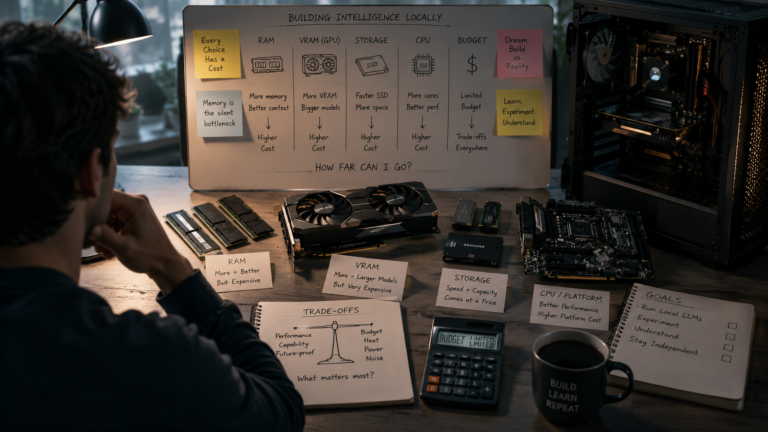
At first these felt like separate, unrelated observations. But they kept connecting. To give millions of people that smooth, “remembering” AI experience, you need real infrastructure. Conversations have to be stored. Context has to be processed every single time. Models have to run. All of it needs RAM, VRAM, high-bandwidth memory, server racks, cooling, and constant power.
That smooth conversation on your screen comes with a very physical bill.
The AI does not remember me the way I remember my childhood. It remembers me the way a file cabinet remembers a document. Useful, searchable, sometimes intimate, but not alive.
AI sells us the feeling of memory while consuming enormous amounts of real, physical memory to manufacture that feeling at scale
The Dependency Loop
Memory prices do not rise because of one single cause. Supply chains are complicated. Demand comes from phones, laptops, gaming, enterprise computing, and dozens of other industries. It would be unfair to blame AI alone. But here is what I noticed:
More people including myself, use cloud AI because it is convenient. These tools feel more useful the more continuous they seem. That continuity needs infrastructure. The infrastructure needs high-performance memory. Memory manufacturers follow the largest buyers, the hyperscalers and enterprise contracts. Consumer hardware quietly becomes less of a priority.
And when building locally gets harder, more people lean on the cloud tools that are already there. The loop feeds itself because that is how markets work.
The Cost Nobody Puts on the Invoice
Scaling AI always comes with costs that never show up on any invoice. Training large models uses as much electricity as small towns do over the course of months. Data centers need vast amounts of water for cooling, millions of liters per day in some places. The chips themselves require rare materials and energy-intensive manufacturing, before a single word has ever been written. We experience AI as text on a screen. Instant. Clean. Effortless.
But that text passed through a building that was running hot, being cooled with water, drawing power from the grid.
I am not saying this to lecture anyone. I am saying it because this cost is almost entirely invisible to the average user. And things that are invisible have a habit of growing without anyone noticing.
I Am Not Writing This From the Outside
I should be honest: I used AI to organise some of these thoughts before writing. So I am not pointing at a machine I have nothing against . I use these tools. There are days when they really make me think better.
This is not an anti-AI argument.
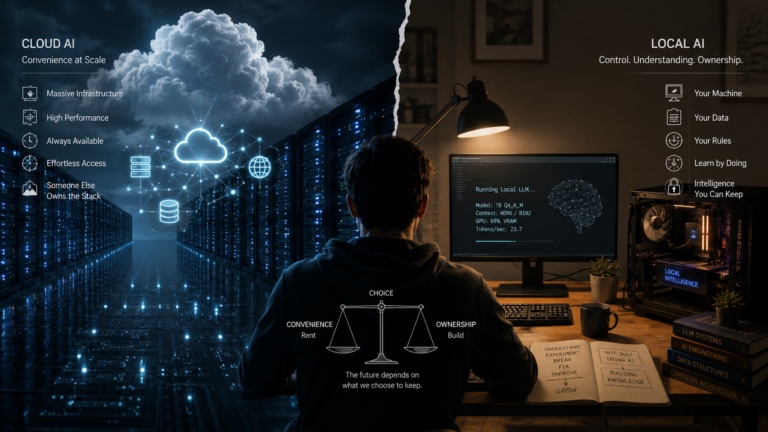
What I am uncomfortable with is dependency that arrives slowly, dressed as convenience and the fact that the infrastructure behind our thinking tools is increasingly something most of us do not own, cannot see, and have no control over.
It is always good to know what your tools actually do, not just to benefit from the fact that they do.
Toward a Different Kind of Memory
The more I think about this the more I keep returning to one fundamental issue.
For decades, computers have kept memory and processing as two separate things. Data stays in one place, goes to the place where it is processed, then goes back. That movement has always had a cost in energy, in time, in heat. The cost is harder to dismiss as AI systems get bigger.
What if memory did not just store information, but could actually participate in the computation?
That question led me completely by accident, to a component called The Memristor.
And maybe that is where the next part of this story begins.
Recent Articles
The Founder’s Patent Path (Part 6 of 6) A Visual Strategy Map & Critical FAQs
The Fusion of Art & Technology: A Renaissance or an Insult to Life?
The Illusion of Memory: AI, Scarcity, and the Hidden Cost of Continuity
The “Oak Tree” That Wasn’t! A reflection sparked by art, belief, and a late-night search
Visitor Stats: