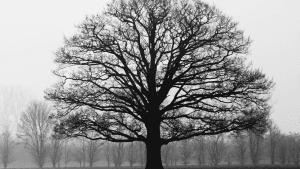
I have never stood in front of Michael Craig-Martin’s “An Oak Tree.” I have never entered the gallery, never looked up at that glass of water on a shelf. But a decade ago, I remember exactly when I first heard about it.
It was a casual evening conversation with a friend Promit Basu, the kind of person who gently hovers between philosopher and artist without ever needing to wear the label. He mentioned, almost in passing, that there was a famous artwork where a glass of water was claimed, quite literally, to be an oak tree.
I paused.
“Wait… what?” He smiled. “Exactly.”

A Search, A Click, and a Quiet Shock
Later that night, curiosity got the better of me. I searched for it online and there it was! A simple glass of water, perched on a mounted glass shelf. Nothing dramatic about the setup. No special lighting. No grand gestures. Just… water in a glass.
But beside it, a short printed dialogue. In it, the artist calmly explains that the glass of water has been transformed, not symbolically, not metaphorically but literally into a full-grown oak tree. He insists on it. With complete conviction. As someone grounded in logic and electronics, debug logs, pin voltages, thermal traces, I had two simultaneous reactions:
“This is ridiculous.” And… “Wait. Sit with it.” So I did.
Not Just a Joke
Until that moment, I thought art was supposed to look like something. Be something. A sculpture you could touch or walk around. A painting that showed you a story. But this?
This was different. It didn’t offer anything to admire. It offered something to think through.
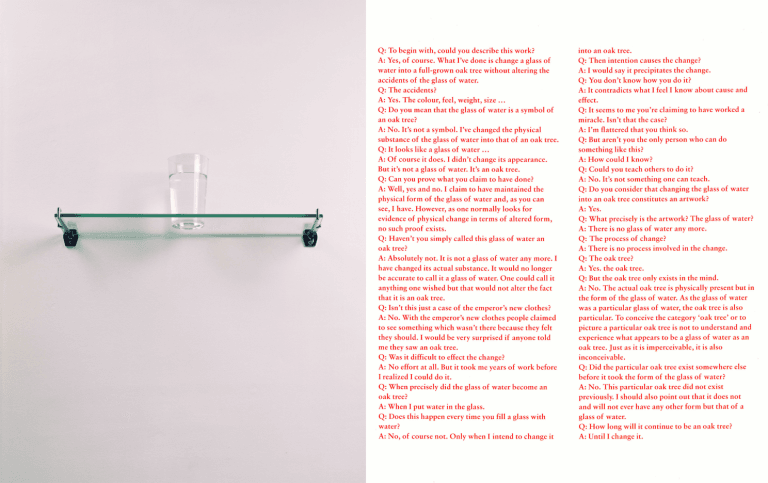
Craig-Martin knew exactly what he was doing. He was not trying to fool anyone. He knew, and we know that it is a glass of water. But his insistence that it is an oak tree pushes us into a strange mental space. An uncomfortable gap between what we see and what we are being told. Between what we believe and what we are asked to believe. And that gap, that line of tension, is where the real artwork lives.
Not in the water. Not in the glass. But in the pause. In the moment, where your certainty is challenged.
What Do We Call “Real”?
It made me ask questions I was not expecting. What do we accept as “real” just because someone says so? How much of our world is built on collective agreement rather than physical proof? Is belief powerful enough to make something “true”? Can the act of naming something transforms it?
Think about it.
We believe in money. In nations. In brands. In marriage. In god(s). In love. None of these are things we can hold or measure, yet we treat them as deeply real, often more real than the things we can touch.
So then, is an oak tree in a glass of water really that strange?
Belief Isn’t the Enemy of Truth. Maybe It is the Beginning
For an engineer, this was hard. As someone who builds and breaks things for a living, where 5 volts is 5 volts, and a resistor does not magically become a capacitor because someone says so, this realization shook something inside me. As someone grounded in logic, I used to think belief and truth were on opposite sides. That belief was what we held in absence of evidence, and truth was what we proved.
But now I am not so sure!
When we build a prototype, the first version almost never works. But we believe it can. When we learn something new, we might not fully understand it, but we trust the process. When we meet someone and feel a connection, we don’t have proof, we just sense it.
So, maybe belief doesn’t come after truth. Maybe it comes before. Maybe belief is the bridge that carries us toward truth.
Promit Da Was Right!
I have never seen “An Oak Tree” up close. But I don’t think I need to. It worked its way into my mind through a friend’s casual comment, a search result, and a simple photograph. It showed me that art does not always need a canvas. Sometimes, it just needs a thought.
When Promit Da said “a glass of water is an oak tree,” he was not trying to be edgy. He was passing on a kind of invitation. An invitation to pause. To suspend certainty. To see how much of our worldview is stitched together by shared illusions and how easily it can be unraveled by a single sentence.
It made me realize that clarity is valuable but so is curiosity. That logic is essential but so is imagination. That sometimes, the questions are more important than the answers. So, if someone ever tells you, “This is not what it seems,” maybe don’t rush to prove them wrong. Maybe pause. Maybe look again.
And if they say, “This glass of water is an oak tree,” you don’t have to believe them. But maybe… just maybe… ask yourself: “What would change if I did?”
That is the quiet power of “An Oak Tree.”
It doesn’t shout. It just waits. And if you’re paying attention, it whispers:
“What if everything you know is based on trust, not proof?”
So, Is It Really an Oak Tree?
Honestly, I don’t think that matters. The better question might be: What are you seeing? And what are you believing? Because sometimes, the most extraordinary transformations happen quietly, not in matter, but in meaning.
Read More: : https://lnkd.in/dG6cVgpf


 Total Users : 114
 Views Today :
 Total views : 787
 Your IP Address : 95.217.114.145