Here is the uncomfortable truth: The more experienced someone becomes, the less they trust single answers. People seriously overestimate how much mastery comes from finding “the right answer.” I used to make the same mistake. For years, I thought every complex field, law, engineering, strategy, markets, was hiding one big explanation that only experts knew. If I could just find that one perfect rule or principle, everything else would fall into place.
After a decade working across multiple disciplines, that belief feels almost naïve. There is no final answer. There never was. Experts operate on something far more robust: frameworks. This shift from chasing answers to building frameworks, is the quiet turning point in every practitioner’s growth. You don’t notice when it happens. You only notice the consequences: decisions become sharper, mistakes reduce, and ambiguity stops feeling threatening.
This is the architecture behind that shift.
Why Beginners Crave the One Big Answer
When people enter a new field, their instinct is to look for rules that offer deterministic certainty. It makes perfect sense. A single answer reduces cognitive load. It removes fear, judgment and even sometimes – responsibility.
“What’s the right choice?” “Tell me what to do here.” “Is this correct or wrong?”
The assumption is that the related field operates like a automation flowchart. Pull the right lever and good things happen. Pull the wrong one and chaos follows. And to be fair, some early learning works that way, foundational concepts often do look like rules. That is what makes the illusion so persistent.
But the moment you deal with real-world stakes, this collapses fast.
Founders who ask for “the best strategy,” engineers who want “the correct architecture,” and managers searching for “the right decision” are repeating the same mental mistake: assuming the problem is simple enough to be solved by a single universal rule.
Complex fields don’t reward that thinking. They punish it.
Why Experts Don’t Trust Answers
If you observe world-class professionals long enough, you notice something strange: the more experienced they are, the less definitive they sound. Not because they are unsure. Because they understand how the landscape works. Experts know that:
- Context shifts the problem
- Trade-offs shift the solution
- Markets shift the incentives
- Timing shifts the risks
- Information shifts the decision
A beginner expects consistency across situations. An expert expects variation. This is why good advice often sounds frustratingly conditional.
“It depends.” “In this scenario, maybe.” “Only if these constraints hold.” “Under these conditions, yes, otherwise no.”
Beginners hear uncertainty. Experts hear precision.

When your mental model of a domain becomes rich enough, absolute answers start to look childish. Reality refuses to behave consistently enough for rules to survive unchanged. So instead of answers, experts rely on frameworks. Structured ways to think, not predetermined conclusions.
Frameworks: The Operating System Behind Expertise
A framework is not knowledge. A framework is how you use knowledge. It is a reusable pattern of reasoning. Identify → Evaluate → Compare → Decide.
Frameworks work because they can survive volatility. Answers can’t. An answer is a destination. A framework is the compass that works in any terrain. Once you see the difference, you can never unsee it.
Think about any field:
A technical architect doesn’t ask, “What’s the right design?” They ask, “Which constraint dominates this system? Performance? Cost? Scalability?” and choose accordingly.
A strategist doesn’t ask, “What’s the best entry plan?” They ask, “What are the competitive asymmetries? Where’s the leverage point?”
A founder doesn’t ask, “What’s the correct move?” They ask, “What’s the downside if I’m wrong? What’s the optionality if I delay?”
Everything becomes an evaluation of conditions, not a hunt for a perfect answer.
This is why frameworks matter. They’re not shortcuts, but repetition-optimized thinking structures that prevent you from starting from zero each time the environment shifts.
The Silver Bullet vs the Toolbox
If you want one image that captures the difference between amateurs and practitioners, it’s this: Beginners look for a silver bullet. Experts build a toolbox. The silver bullet is seductive. It promises clarity, safety and inevitability. It never exists. The toolbox is messier but far more powerful. Each tool has a purpose and failure mode. Each tool is situational.
The skill lies not in possessing tools, but in choosing which one to apply under which circumstances and knowing when to discard the tool entirely. In real work, the person with five well-understood frameworks will outperform the person with 500 memorized facts every single time.
Facts answer yesterday’s problems. Frameworks answer today’s.
How My Own Thinking Broke and Rebuilt Itself
Early in my career, I tried to brute-force understanding by accumulating more and more information. More textbooks. More lectures. More opinionated experts.
But it didn’t compound. It bloated.
The turning point came when I realized that I wasn’t struggling because the field was complicated. I was struggling because I was thinking about complexity with the wrong mental tools.
Every time I tried to reduce something into a single rule, I ended up with contradictions. Every time I tried to find the “right” method, exceptions ruined the clarity. Every time I thought I finally understood the landscape, a new scenario exposed all the gaps. That’s when it became obvious: I wasn’t missing answers. I was missing frameworks.
Once that clicked, learning accelerated in a way that surprised me. I stopped asking for prescriptive clarity and started building conditional reasoning:
• What variables matter here? • What changes if one assumption shifts? • What is the risk profile? • What is the time horizon? • What is the incentive structure? • What does this look like from the opposite angle?
With every domain I studied after that, engineering, product, law, strategy, the pattern repeated. Answers helped me start. Frameworks helped me stay grounded as things became more intricate.
The Hidden System Behind Expert Decision-Making
Strip away the surface, and every expert uses some version of the same internal workflow:
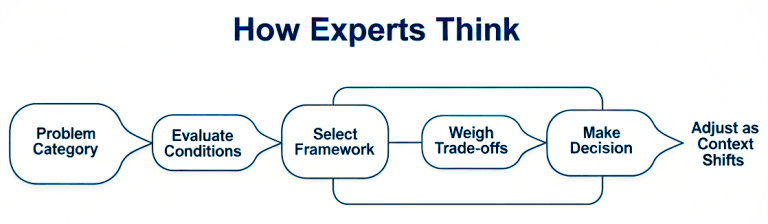
- Identify what kind of problem this is.
- Evaluate the situation to categorize the issue.
- Select the framework that best fits the category.
- Draw boundaries: what’s true, what isn’t, and what’s unknown.
- Make a decision with the best available information.
- Adjust when the environment shifts.
This kind of reasoning doesn’t look dramatic. It looks calm, structured, and almost boring. That is the point. Good decisions come from well-built mental scaffolding. Bad decisions come from the desperation to find shortcuts.
The Takeaway
The illusion of the “one right answer” is the biggest barrier between beginners and real expertise. The moment you stop chasing perfect explanations and start assembling the frameworks you need to navigate uncertainty and your thinking pattern changes permanently.
It becomes clearer. It becomes faster. It becomes adaptable. The world is too dynamic for static certainty. Frameworks survive volatility. Answers don’t. In law, in engineering, in strategy or any in specific domain, mastery is nothing more than your ability to deploy the right framework under pressure.
The rest is detail.
Read More: https://lnkd.in/dG6cVgpf


 Total Users : 110
 Views Today : 20
 Total views : 782
 Your IP Address : 89.117.72.154