
Prelude: In Part 4, Luna used the Divisional Application to turn a “lack of unity” objection into a strategic win, securing two granted Indian patents (Algorithm and Frame Design) with the same priority date. With her core V1.0 IP secured, her team moved on to its next challenge: improving the product without overspending on protection.
Month 48. Luna’s patent portfolio was finally solid: two main Indian patents granted, and her international filings were progressing well. She could finally focus on what she did best: building better technology. The engineering team delivered the solution to the next problem: a foldable landing gear system. When retracted, it folded flush against the drone’s body, reducing the storage footprint by 40%.The mechanism was elegant. A spring-loaded hinge with a magnetic lock.
Luna knew immediately this was valuable. Customers would pay for it. Competitors would copy it if they could. But it was also clearly an incremental improvement, not a revolutionary breakthrough. It enhanced her existing patented drone design; it didn’t replace it.
Filing a new, full patent application for this feature meant staring at a massive cost:
- Immediate Costs: Filing fees, attorney fees, and prosecution costs
- Long-term Burden: 20 years of escalating renewal fees for a feature that might only be relevant for 8-10 years
- Opportunity Cost: Money spent on excessive patent protection couldn’t be used for further R&D
The total lifetime cost felt wasteful for a simple upgrade. Her consultant mentioned something during their last call: “Have you considered a Patent of Addition (POA)?”
The Patent Type That Rewrites the Economics of Innovation
The Patent of Addition is designed precisely for Luna’s situation: protecting improvements or modifications to an already patented invention without the cost burden of a full patent.
The comparison that sold Luna was purely economic:
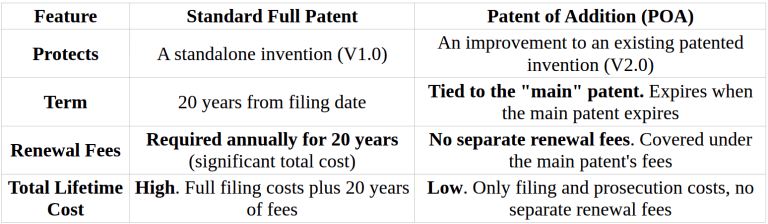
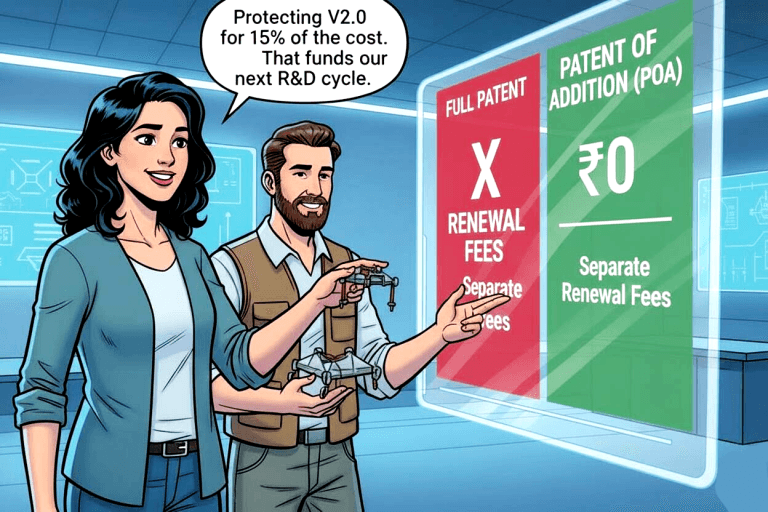
The Patent of Addition would cost roughly 15% of what a full patent would cost over its lifetime. The renewal fee savings alone could fund another round of R&D. Since the landing gear was explicitly designed for Luna’s already-patented drone frame, it made perfect strategic sense. Luna filed the Patent of Addition, claiming it as an improvement to her frame design patent.
The Conditions Most Founders Miss
While the cost savings are huge, the POA has specific requirements that limit when you can use it:
- Same Applicant: You must be the applicant or patentee of the original “main” patent. You cannot file a POA for an improvement to someone else’s patent.
- Novel Improvement: The improvement must be new and not already covered by the main patent’s claims.
- Main Patent in Force: The main patent must still be active (i.e., renewal fees paid). If the main patent lapses or is revoked, the POA automatically lapses with it.
- Must Relate: The improvement must have a clear technical connection and relate to the main invention.
Luna’s foldable landing gear, which attached to and enhanced her patented frame, met all four conditions.
The Trade-Offs: The Risks Luna Accepted
The consultant was clear about the strategic trade-offs for accepting the cost savings:
- Risk 1: Tied Fate. If Luna ever stops paying the renewal fees on her main frame design patent—perhaps because that technology becomes obsolete—her Patent of Addition automatically lapses with it. She can’t keep one and abandon the other.
- Risk 2: Limited Term. Her main patent was filed at Month 12. Her POA was filed at Month 48. The POA will expire at the same time as the main patent, giving her only 16 years of effective protection instead of a fresh 20-year term. This is the fundamental trade-off: cost savings in exchange for a term tied to the main patent’s lifecycle.
- Risk 3: Strategic Inflexibility. The POA protects an improvement in the context of the main invention. If a competitor wanted to license just the landing gear technology for a non-drone application (like a solar panel stand), Luna couldn’t easily grant that license without also dealing with the main patent. The POA cannot be separated.
Luna weighed these risks against the cost savings and accepted them. For a hardware startup where product cycles move fast, a 16-year term was sufficient, and the renewal fee savings could fund an entire next innovation cycle.
The Final Lesson: Innovation is a Process
Luna’s journey taught me something that wasn’t obvious from studying patent law in isolation: Innovation isn’t a single moment. It’s a continuous process. The patent system isn’t just about protecting static inventions, but also about supporting dynamic innovation.
- Breakthroughs (V1.0): Get a Full Patent (20-year term, independent life, high cost).
- Incremental Improvements (V1.1, V2.0): Get a Patent of Addition (Cost-efficient, tied to main patent, zero separate renewal fees).
What if an improvement becomes revolutionary?
The law provides a safety net: Luna can request conversion from a Patent of Addition to a full, independent patent if the invention proves significant enough. This gives her flexibility, but it comes with the corresponding cost burden (a new 20-year term and full renewal fees). The system is flexible, but you are required to make a choice.
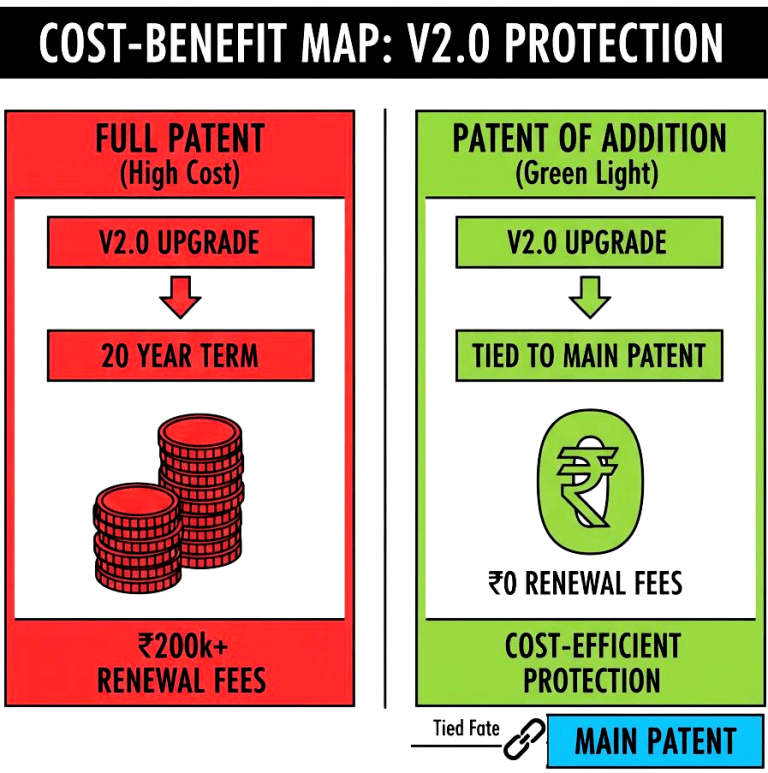
Month 60. Luna’s IP portfolio is now: two main Indian patents, one Patent of Addition (foldable landing gear), and several granted international patents. Her annual IP maintenance costs are roughly 40% lower than they would have been if she’d filed all full patents.
She learned to think strategically about different types of protection for different types of innovation. The system offers the tools. Her job is choosing the right one for each situation.
𝐍𝐞𝐱𝐭 Part 6: The Founder’s Patent Path: A Visual Strategy Map & Critical FAQs (Consolidating the entire toolkit).
Frequently Asked Questions (FAQs)
Q1: Can I file a Patent of Addition if my main patent is still pending (not yet granted)?
Yes. The law explicitly allows filing a Patent of Addition while the main application is pending or after the main patent is granted. This is useful if you develop an improvement during the prosecution of your main application.
Q2: What happens to my Patent of Addition if I sell or license my main patent?
The Patent of Addition transfers with the main patent. You cannot separate them. If you assign or exclusively license your main patent to another party, the POA goes with it unless explicitly excluded in the agreement (which would be highly unusual).
Q3: Can I file multiple Patents of Addition to the same main patent?
Yes. There’s no limit to how many Patents of Addition you can file for a single main patent, as long as each addition covers a novel improvement. This is perfect for product platforms that evolve continuously, protecting each significant enhancement without the cost burden of multiple full patents.
Q4: Does "no renewal fees" mean the Patent of Addition is completely free to maintain?
Not quite. You still pay the main patent’s renewal fees, which cover both the main patent and all Patents of Addition associated with it. If you have one main patent and three Patents of Addition, you only pay one set of renewal fees total, not four separate sets. This is where the cost efficiency really compounds.
Q5: If my main patent expires after 20 years, what happens to my Patent of Addition?
The POA also expires at the same time. The Patent of Addition cannot outlive the main patent. This is the fundamental trade-off: you get cost savings (no renewal fees) in exchange for a term tied to the main patent’s lifecycle. If you filed the POA late in the main patent’s term, you might only get a few years of protection.
The End of Luna’s Journey (and the beginning of yours)
I’ve documented the Provisional Application, PCT vs. Paris, the Dual-Track mistake, the Divisional rescue, and the Patent of Addition strategy. The entire IP toolkit laid bare.
What strategic choice in this series resonated most with your own experience as a founder or CTO? Let me know in the comments.


 Total Users : 109
 Views Today : 17
 Total views : 779
 Your IP Address : 103.171.45.137