
Prelude: In Part 3, Luna learned the hard lesson that delaying her home market filing cost her 18-24 months of competitive advantage when a sudden policy shift created massive domestic opportunities. Committed to the long timeline, she entered the Indian national phase through her PCT application at Month 31.
Luna was already navigating a competitive disadvantage. Then, at Month 35, the First Examination Report (FER) for her Indian application arrived with a stark and unexpected objection:
Lack of unity of invention
Luna read it three times, trying to decode the examiner’s position. It felt arbitrary: Her application claimed both her drone stabilization algorithm and the physical frame designas a single, integrated invention. The Patent Office disagreed, requiring them to be split into two separate applications.
From an engineering perspective, this made no sense. The algorithm’s effectiveness depended on precise sensor placement in the frame. The frame’s aerodynamics were optimized for the algorithm’s real-time adjustments. They were an integrated system.
But patent law doesn’t always align with engineering logic. The examiner wasn’t asking, “Do these elements work together?” They were asking, “Do these elements solve the same technical problem in the same way?”
- The Stabilization Algorithm: Solves the problem of maintaining drone position in turbulent wind conditions (through software-based real-time adjustments).
- The Frame Design: Solves the problem of aerodynamic efficiency and sensor integration (through physical structure).
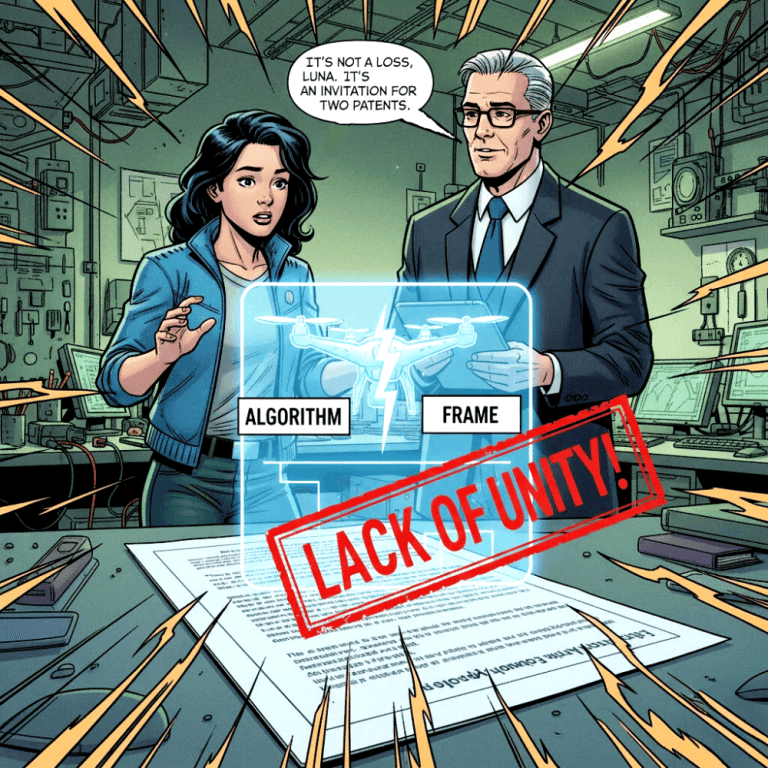
Two different problems. Two different solutions. According to patent law, that meant two inventions. Luna was effectively being told she had to choose: abandon the frame design to keep the algorithm, or vice versa. “Do I seriously have to give up half my invention?” she asked.
The Rescue Mechanism: The Divisional Application
Her patent consultant’s response provided a wave of relief: “No. You don’t have to choose at all. This objection is not a loss; it is rather an invitation to file a Divisional Application.”
The Divisional Application is a strategic tool that allows you to split one application containing multiple inventions into separate applications.
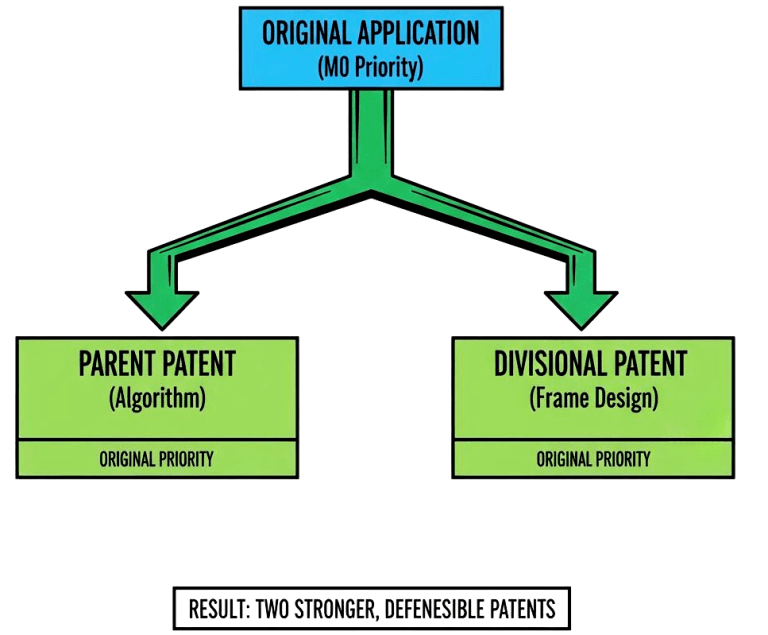
The Critical Part: You do not lose your priority date.
- Parent Application: Keeps one invention (e.g., the Algorithm).
- Divisional Application: Claims the second invention (e.g., the Frame Design).
The Divisional is treated as if it was filed on Month 0, the date of her original Provisional Application. The application is a continuation of the original disclosure, ensuring that any prior art published in the 35 months since then cannot be used against the new Divisional claims.
This reframed the entire objection for Luna: The Patent Office was telling her that her invention was so comprehensive, it deserved two patents instead of one.
The Strategic Split Luna Made
Luna immediately filed the Divisional Application. This action had to be taken quickly, as the window to file a Divisional closes when the parent application is granted.
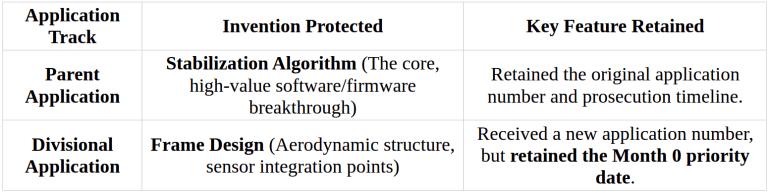
Both applications then proceeded independently. Within six months, both were granted. Luna now held two patents, both claiming priority from the same date, protecting different, defensible aspects of her integrated drone system. The unity objection that had initially felt like a setback had actually forced her to secure broader, more defensible protection.
What This Taught Me About Patent Office Logic
This entire event shifted my understanding of these objections. Unity of invention requirements are not designed to limit protection; they are designed to ensure thorough examination. When a single application covers multiple, distinct inventions, the examiner cannot give each one the scrutiny it deserves within a single process.
By forcing the split, the Patent Office ensures:
- Each invention is examined against its own relevant prior art (the Frame against physical structure art, the Algorithm against software art).
- Claims are crafted specifically for each technical problem.
- The scope of each granted patent is clear and defensible.
The forced split wasn’t a penalty. It was a structural requirement for thorough examination, leading Luna to end up with stronger patents because each one was focused and precisely tailored to its specific innovation.
The Scenarios Where Divisional Applications Save You
Luna’s case is just one scenario where the Divisional Application becomes a critical strategic tool:
- Scenario 1: The Unity Objection (Luna’s Case): The examiner disagrees that your application covers a single invention and forces a split. The Divisional rescues the “abandoned” invention without losing its priority date.
- Scenario 2: The Strategic Hedge: During prosecution, you realize one claim set is strong and likely to be granted quickly, while another requires complex arguments. You file a Divisional to separate them, allowing the strong claims to proceed to grant immediately while you fight for the complex claims separately.
- Scenario 3: The Market Pivot: You filed an application covering both hardware and software. Your business pivots to focus only on software licensing. You file a Divisional to separate the hardware claims, potentially abandoning them later while maintaining strong software protection.
- The Timeline Constraint: Under Indian patent law, you must file the Divisional Application while the parent application is still pending (before it is granted, rejected, or abandoned). Once the parent patent is issued, the window closes permanently. This creates urgency.
With her core IP secured, Luna’s focus shifted to continuous innovation. Her team had already moved on to the next problem: inefficient storage and transport. The solution was a foldable landing gear system. A useful, marketable, but clearly incremental improvement on her existing patented frame design.
Filing a new, full 20-year patent for this felt wasteful. There had to be a better way to protect her V2.0 without breaking the bank.
Next Part 5: How to Protect Your Product Upgrades Without the 20-Year Cost. (The final lesson: how to protect incremental improvements without the cost burden of a full patent.)
Frequently Asked Questions (FAQs)
Q1: Can I file a Divisional Application if my main patent is still pending (not yet granted)?
Yes. The law explicitly allows filing a Patent of Addition or a Divisional Application while the main application is pending or after the main patent is granted. You don’t need to wait for grant.
Q2: Can I file a Divisional Application preemptively, before the examiner raises a unity objection?
Yes, absolutely. If you realize during prosecution that your application covers multiple distinct inventions, you can voluntarily file a Divisional at any time before the parent is granted. This can be highly strategic if you want different prosecution timelines or claim strategies for different inventions.
Q3: If my Divisional gets the same priority date as the parent, can I claim the same invention in both?
No. This would be “double patenting.” The Divisional must claim a different invention than the parent, even though both share the same priority date. The Patent Office will reject claims that overlap substantially between parent and divisional applications.
Q4: What happens if I don't file a Divisional and just let the examiner's unity objection stand?
You must choose which invention to pursue in the parent application. The other invention is effectively abandoned from that application. You cannot revive it later through a Divisional once the parent is granted. The disclosure remains in your specification, but you have no enforceable claims for it.
Q5: Does the Divisional Application go through full examination like a new application?
Yes. The Divisional is examined independently by the Patent Office. It will receive its own examination reports, and you’ll need to prosecute it separately from the parent. The only thing it inherits is the priority date, everything else (examination, objections, amendments) happens independently.


 Total Users : 111
 Views Today : 2
 Total views : 784
 Your IP Address : 54.39.89.199