Ten months had passed since Luna filed her provisional application. The expo had delivered everything she’d hoped for: investor interest, media coverage, and early customer leads. The drone prototype was no longer scattered on a workbench. It was flying, stable in winds that would ground most commercial drones.
But success creates its own pressure.
Luna’s lead investor called a strategy meeting. He pulled up a market analysis that made her stomach tighten. “Your technology is brilliant,” he said. “But your customers aren’t just in India. Germany dominates industrial drone regulations. The US has the massive delivery market. Japan is emerging fast in disaster response. If we don’t protect your IP in these territories, we are handing competitors a blueprint the moment we enter those markets.”
The clock was visible on every calendar. Luna had roughly two months left before her 12-month priority window in Indian patent Office, secured by the provisional application, closed. After that deadline, she would lose the ability to claim her original Indian filing date in other countries. The challenge was immediate: How do we go global without burning through half our funding round on patent fees?
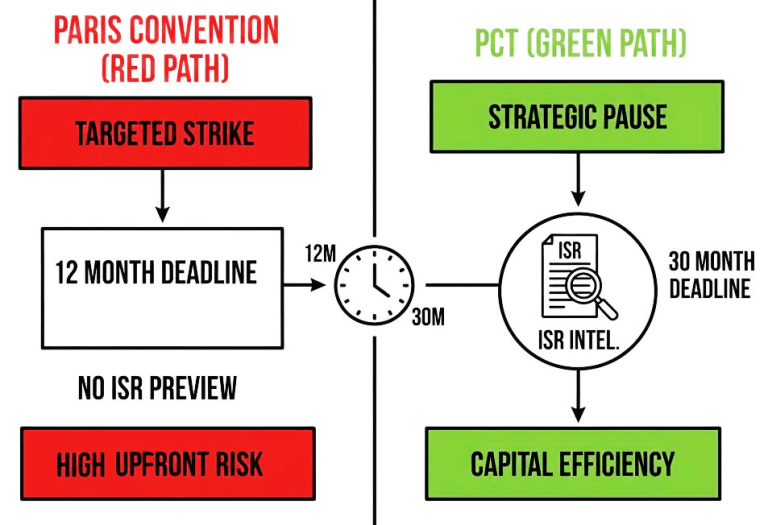
Luna had to choose between two routes to secure her priority date in foreign jurisdictions: a Targeted Strike (Paris Convention) or a Strategic Pause (PCT). The choice determined whether she would have 12 months or 30 months to decide which markets truly mattered.
The Confusion That Makes Founders Panic
When most founders first study international patent filings, they assume it is straightforward, you file in your home country, then somehow “extend” it elsewhere. But the reality is more nuanced and more strategic.
The crucial distinction that changes everything:
- Filing an Indian Patent Application: You seek protection only in India. One country. One examination.
- Filing a PCT (Patent Cooperation Treaty) Application: You are not filing for protection in India. You’re filing an international application through India, that gives you the option to pursue patents in over 150 member countries later.
That distinction, “filing in a country versus filing through a country” to access a global system changes everything about strategy. The PCT is a filing system, not a patent-granting system. It buys you time and information, but you must still file separate national phase applications in each country to get actual protection.
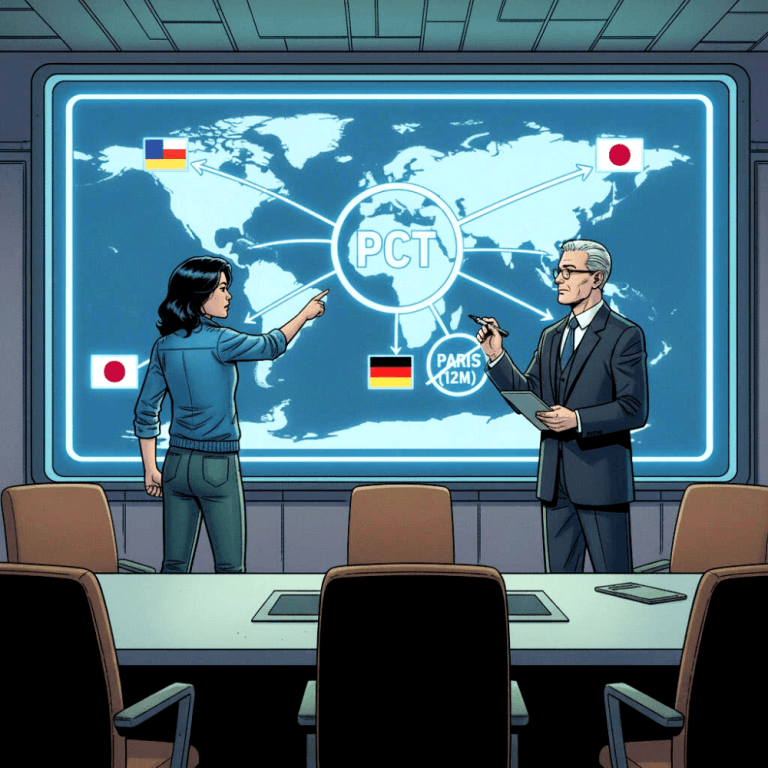
Option 1: The Paris Convention Route (The Targeted Strike)
Luna’s initial thinking was engineer-logical: “We know our target markets: Germany, USA, Japan. Let’s file directly in those three countries under the Paris Convention before the 12-month deadline. Clean, direct, done.”
The Paris Convention allows you to file your first application in one member country (India) and then, within 12 months, file separate applications in any other member countries, claiming your original Indian priority date.
Advantages (Speed & Simplicity)
- Faster to Final Decision: Examination starts immediately at Month 12-13 in each country
- Lower Initial Cost: For a fixed, short target list (3-4 countries max)
- Simpler Conceptually:Direct line from filing to grant in each country
Luna almost committed to this path. It felt decisive. Then her consultant asked the question that shifted everything:
“What if the real opportunity turns out to be Australia or Singapore markets you haven’t seriously evaluated yet? And what if there is prior art we haven’t discovered that makes your core claims unpatentable? Would you rather find that out after spending fifty thousand dollars, or before?” Luna didn’t have confident answers. Her market projections were educated guesses wrapped in hopeful spreadsheets.
Disadvantages (Risk & Cost)
- The Decision is Permanent: Once the 12-month deadline passes, you’re locked out of all other 150+ countries or re-enter with a later priority date which might be riskier.
- No Preview of Patentability: You commit tens of thousands without knowing if your core claims will survive examination
- Simultaneous Expense: All major filing and translation costs hit your seed capital budget at once
Option 2: The PCT Route (The Strategic Pause Wins)
The PCT system’s value is that it extends your decision deadline. Instead of 12 months from your priority date, a PCT application gives you 30 months in most jurisdictions to file a patent application in the member countries. (31 months in India and 20 months in some countries, if no international preliminary examination is requested). That’s an additional 18 to 19 months of runway beyond what the Paris Convention offers.
For a startup in Luna’s position, this window is priceless. Her 12-month provisional period gave her time to build the tech. The PCT gave her 30 months to understand the business.
What Luna bought with her PCT filing:
- Time to Validate Markets: She could delay the expensive national filings until Month 30, based on actual commercial traction and customer data, not just early-stage speculation.
- Flexibility for Market Surprises: If Australia or South Korea emerged as unexpected opportunities between Month 12 and Month 30, she could still enter those markets with her original priority date intact.
- Capital Efficiency Timing: Her Series A funding was projected to close around Month 24. PCT allowed her to delay the expensive national phase filings until after she had capital, rather than burning precious seed funding at Month 12.
But the feature that made PCT the clear winner was the International Search Report (ISR).
The Expensive Beta Test That Saves You From Catastrophe
When I first encountered the ISR, my engineer brain reacted cynically: “I’m paying significant fees just to get a preliminary opinion?” That framing completely misses the strategic value. The ISR is an International Searching Authority’s comprehensive prior art search. It arrives roughly 9 to 12 months after your PCT filing (around Month 19-21 in Luna’s timeline).
The ISR is a Patentability Stress Test. It reveals:
- What prior art exists that’s similar to your invention
- Which of your claims appear novel and which face serious patentability challenges
- A preliminary written opinion on whether your invention meets the criteria for protection
Here’s why it’s worth the upfront cost: Before you commit six figures to filing in ten countries, you know whether you’re protecting a genuine innovation or funding an expensive rejection.If the ISR is positive, you proceed with confidence. If the ISR reveals fatal prior art problems, you can simply abandon the PCT application, saving yourself hundreds of thousands in wasted national phase entries.
For Luna, this was the deciding factor: Intelligence before commitment. At Month 10, Luna made her choice. She filed a PCT application, claiming priority from her original Indian provisional filing at Month 0. The upfront cost was higher, but the strategic optionality was undeniable.
Luna had made the right choice for a high-uncertainty startup. But there was one more decision waiting at Month 12, one related to her home market that would come back to haunt her in ways she didn’t yet understand.
That decision, and what it cost her, is the story of Part 3.
Next Part 3: The Home Market Blindspot: How to Avoid Losing Your Competitive Edge. (The brutal lesson that strategic flexibility abroad can cost you critical speed at home.)
Frequently Asked Questions (FAQs)
Q1: If PCT gives so much flexibility, why would anyone choose Paris Convention?
Speed and certainty. If you’re 100% certain about your target markets (e.g., signed distribution contracts in specific countries), Paris Convention gets you to national examination faster. For some industries, patent grant timing impacts licensing deals or regulatory approvals, and that speed matters more than flexibility.
Q2: Does filing a PCT application mean I'm automatically protected in 150+ countries?
No. This is the most dangerous misconception about PCT. PCT gives you the option to pursue patents in member countries. To actually get protection, you must still file separate national phase applications in each target country by the deadline (typically 30 or 31 months from your priority date).
Q3: How much does PCT actually cost compared to filing directly via Paris Convention?
Upfront, PCT is more expensive due to international filing and search fees. However, if you’re targeting 3+ countries, PCT often becomes cheaper overall because you’re delaying the expensive national phase filings by 18 months. The real question isn’t “which is cheaper” but “which gives me better information before I commit major capital.”
Q4: What happens if the International Search Report says my invention is NOT patentable?
You have strategic options. You can amend your claims to address the cited prior art before entering national phase. You can narrow your claims to focus only on the novel aspects. Or, if the problems are fundamental, you can choose not to enter national phase in any country, saving thousands in prosecution costs. The ISR is a checkpoint that saves you from catastrophic waste.
Q5: What happens if I miss the 12-month deadline for filing the PCT?
The 12-month Paris Convention deadline applies to PCT just as strictly as it does to direct foreign filings. If you miss that window, you lose your priority date permanently. You can still file a PCT application with a new priority date, but you’ll be vulnerable to anything published in the intervening gap, including your own public disclosures.
Learn More: https://lnkd.in/dpqWrKdF


 Total Users : 110
 Views Today :
 Total views : 782
 Your IP Address : 54.90.8.255