When I started learning patent law, I kept asking myself one simple question: why would society give someone the power to stop others from using an idea? It seemed to go against everything I learned about open markets and competition during my years as an engineer.
The Patent Bargain - More Than Just a Monopoly
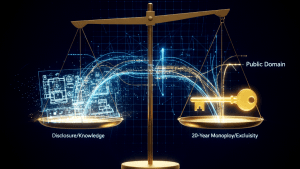
The answer lies in the “patent bargain.” The inventor provides a full, step-by-step disclosure of their creation for everyone to see and learn from. In return, the government grants a 20-year temporary monopoly, allowing the inventor to control who makes, uses, or sells the invention. This deal is essential because it incentivizes R&D investment. Without temporary protection, a competitor could simply copy a costly development the next day. The important part is the long-term benefit: after two decades, that proprietary knowledge enters the public domain, becoming the free foundation for the next wave of innovation.
To ensure this deal is fair, not every new idea deserves protection. Patent systems worldwide use three strict tests to determine if the public is getting enough value in exchange for the monopoly.

The Gatekeepers of Innovation - The Three Pillars of Patentability
Your invention must pass three universal tests to qualify for a patent. Novelty, Inventive Step, and Industrial Application.
Pillar 1: Novelty (The Test of Newness)
Novelty simply means your invention must be absolutely new. No one, anywhere in the world, should have made it public before you filed your patent application.
This check involves searching Prior Art, which is every piece of public knowledge including patents, research papers, products already sold, or even mentions in casual public talks. Most countries follow an absolute novelty standard, meaning if even one obscure document contains all the elements of your invention, your application will be rejected. I’ve seen this happen during my work, inventors are often surprised to find their “groundbreaking” idea was published by a foreign researcher years ago. That is why a thorough prior art search is critical.
Pillar 2: Inventive Step (The Test of Advancement)
Just being new is not enough, your invention must also represent a true technical leap, meaning it cannot be something obvious. For example, if I am the first person to paint a pencil blue instead of yellow, that is new, but it lacks inventive step. Anyone could have thought of it. Thus, it is not patentable.
To judge this, patent examiners use the standard of the Person Skilled in the Art (PSITA). This hypothetical expert has average knowledge in the field. The question is: would this average person, looking at existing knowledge, find your invention obvious? This rule is in place because patents should reward genuine breakthroughs, not minor, routine changes that any professional could figure out.
Pillar 3: Industrial Application (The Test of Usefulness)
The final pillar is straightforward. The real-world utility of the invention. Can your invention actually be manufactured and used in the real world?
This test filters out purely theoretical concepts or devices that violate physics, such as a perpetual motion machine. The invention must be practical and reproducible in industry, be it a product patent or a process patent. This test ensures that the knowledge disclosed is truly useful.
The Bright Line - Distinguishing Discovery from Invention
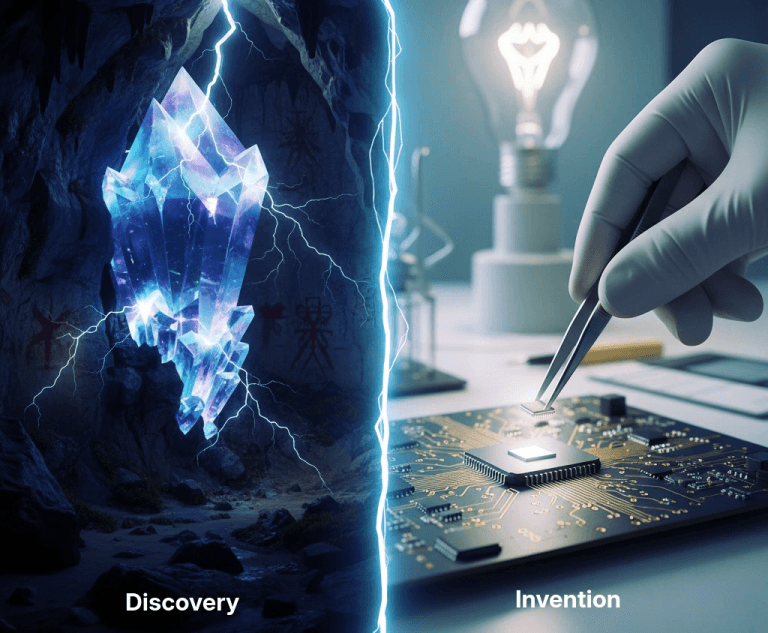
This is probably the most fundamental concept, and honestly, it confused me the most. A discovery is finding something that already exists in nature, for example, Isaac Newton discovering gravity. It’s not patentable. But an inventionis creating something new to solve a problem using that knowledge like Thomas Edison inventing the lightbulb, which applies the discovered force of electricity and creates a utility.
The Product of Nature Doctrine
The Product of Nature doctrine states you cannot patent materials exactly as they exist in nature.
However, the “hand of man” principle introduces nuance. While you cannot patent a substance in its natural form, you can if you isolate, purify, or modify it in a way that creates something with “markedly different characteristics.” The landmark Diamond v. Chakrabarty case established this. This principle is crucial in biotechnology, allowing protection for purified drugs or modified compounds.
Conclusion: A System Designed for Progress
After spending time immersed in patent law, I’ve come to appreciate the elegant design of this system. The three pillars and the discovery/invention distinction ensure we protect human creativity while accelerating technological progress for the collective good.
So here’s my question for you: Which of these three pillars do you think is the hardest for inventors to prove, especially in today’s world where information spreads instantly across the internet?
I’d love to hear your thoughts, especially from those of you who have been through the patent process yourselves.
Frequently Asked Questions (FAQs)
1. Why does society grant a temporary monopoly (a patent) if it goes against open competition?
The temporary monopoly (usually 20 years) is the essential trade-off in the “patent bargain”. It provides the inventor with the incentive to invest heavily in R&D and, most importantly, requires them to publicly disclose the technical details. This disclosure ensures that, once the term expires, the knowledge immediately enters the public domain, benefiting all future innovators.
2. What is the key difference between Novelty and Inventive Step?
Novelty asks if the invention is new (not previously disclosed in prior art). Inventive Step (or Non-Obviousness) asks if the invention represents a true technical leap (means, not easily figured out by a Person Skilled in the respective domain). An invention can be new but still fail the inventive step test if it is merely an obvious combination of existing technology.
3. How extensive is the search for "Prior Art"?
Prior Art is extremely broad and global. It includes any public disclosure, in any format, anywhere in the world, before the patent application filing date. This covers existing patents, published academic papers, public use, public sales, and oral presentations. The standard is typically absolute novelty.
4. Who is the "Person Skilled in the Art" (PSITA), and why is this concept important?
The PSITA is a hypothetical professional, an average, competent practitioner in the specific technical field of the invention. The PSITA acts as the objective yardstick for the Inventive Step test. If the invention would have been obvious to the PSITA, the patent is denied, ensuring only non-obvious, genuine technical leaps are protected.
5. Can I patent a scientific discovery, like a new element or a law of nature?
No. Fundamental scientific laws or entities (the Product of Nature doctrine) are not patentable because they already exist. Patent protection is reserved for the invention, the practical, novel, and non-obvious application or human modification of that discovery (the “hand of man” principle).
6. What happens to the knowledge after the 20-year patent term expires?
After the patent term expires, the invention enters the public domain. This means that any person or company is legally free to use, manufacture, and commercialize the technology described in the patent without requiring permission or paying royalties to the original inventor.


 Total Users : 110
 Views Today : 20
 Total views : 782
 Your IP Address : 89.117.72.154