
AI is getting bigger. Models are larger. Devices are becoming smaller. Energy budgets are increasingly higher. This creates a hard problem. Most computers still separate memory and processing. Data sits in memory. The processor pulls it out, works on it, then sends it back. That movement wastes time and power.
Do Memristors Really Matter?
Memristors offer a different idea. They can store information and help process it in the same place. That makes them important for future memory, edge AI, neuromorphic chips, and in-memory computing.
They are not magic and they are not ready to replace every memory chip yet, but they may become one of the key devices behind faster and more energy-efficient computing. In this articl we are going to understand the What, How and Why.
What Is a Memristor?
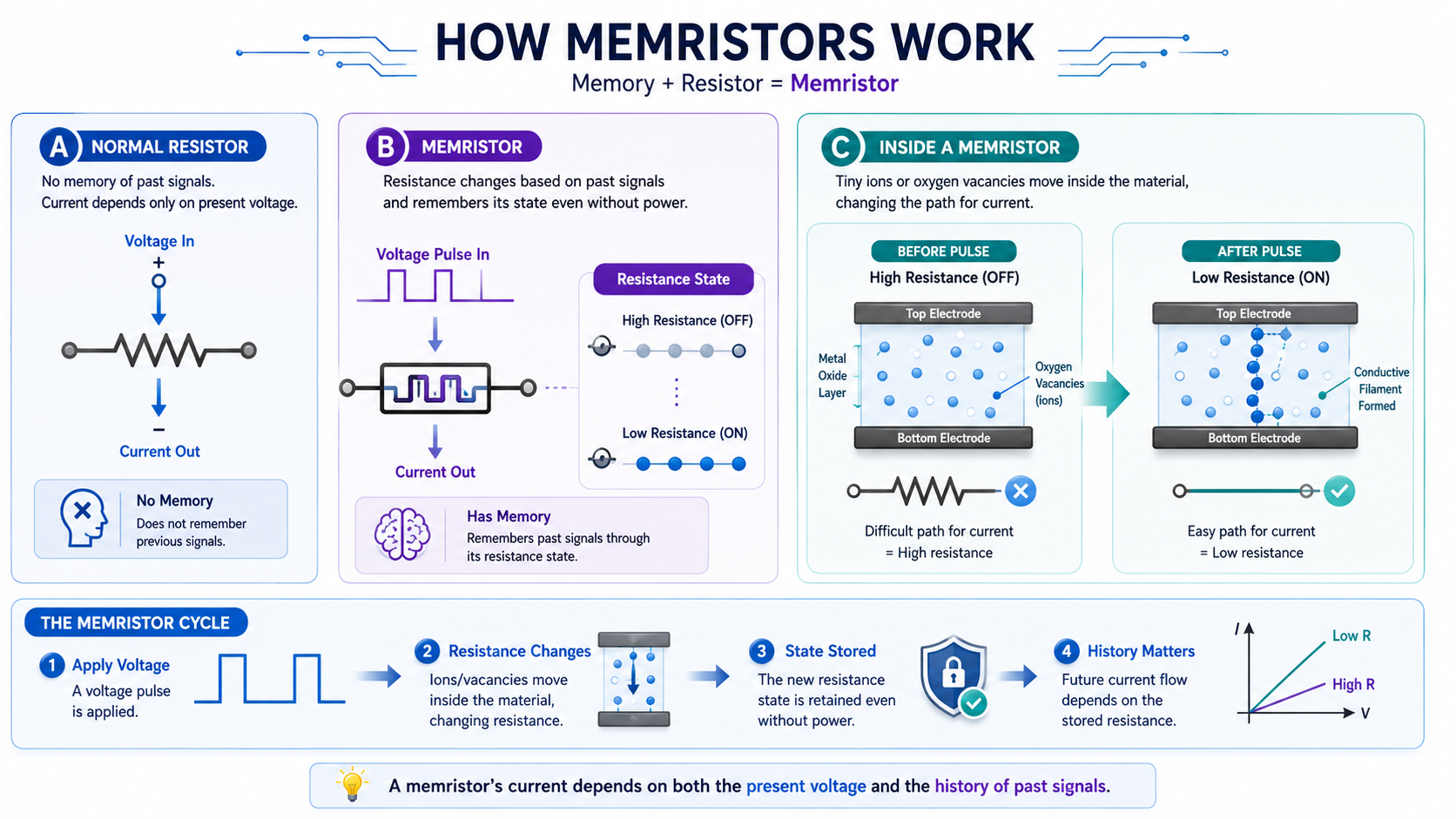
A memristor means memory resistor. A normal resistor controls current. A memristor does something more. Its resistance changes based on the electrical signals that passed through it before. That means it can remember its state. Even when power is removed, the device can keep its resistance level.
A simple example:
Think of a dimmer switch. You move it to a certain brightness. Then you turn the power off. When power returns, it remembers the last setting.
A memristor works in a similar spirit, but at the nanoscale. This is why memristors are useful for non-volatile memory. Non-volatile means the data stays even when power is off. In practical memory research, memristor-like devices are often called ReRAM or RRAM, short for resistive random-access memory.
How Memristors Work
A memristor stores data through resistance. High resistance can represent one state. Low resistance can represent another. Some devices can also hold intermediate levels. That matters because AI does not only need 0s and 1s. Neural networks use weights. These weights can be small, large, positive, negative, or somewhere in between.
A memristor’s conductance can act like a hardware version of a neural weight.
The basic flow is simple:
Apply voltage → resistance changes → new state is stored → future current depends on that state
| State | Meaning | Digital Interpretation |
|---|---|---|
| Low Resistance State | Current flows more easily | 1 |
| High Resistance State | Current flows less easily | 0 |
| Intermediate States | Partial resistance levels | Analog or multi-level memory |
The intermediate states are especially important for AI hardware. Instead of storing only 0 or 1, a memristor can sometimes store multiple conductance levels. These levels can represent neural network weights, similar to how a brain synapse can become stronger or weaker.
Memristors are often arranged in a crossbar array. A crossbar looks like a grid. Wires run horizontally and vertically. A memristor sits at each crossing point. This structure is dense. It also performs one of AI’s most common operations: matrix-vector multiplication. That is why memristors are so attractive for AI hardware.
Memristors vs Traditional Memory
Today’s memory technologies are powerful. But each has limits.
| Feature | DRAM | SRAM | Flash | Memristor / ReRAM |
|---|---|---|---|---|
| Volatile? | Yes | Yes | No | No |
| Speed | Fast | Very fast | Slower writes | Potentially fast |
| Density | High | Low | High | Potentially very high |
| Power Use | Needs refresh | Higher area/power | Low standby power | Low power potential |
| Endurance | Good | Good | Limited writes | Depends on material/device |
| Main Use | System memory | Cache memory | Storage | Emerging memory, AI hardware, embedded memory |
SRAM is great for cache. DRAM is great for system memory. Flash is great for storage. Memristors are different. Their biggest value is not just storage. It is the chance to compute near the stored data. That is the real shift.
Memristor-based ReRAM is attractive because it combines non-volatility, small cell size, low-power operation, and possible compatibility with CMOS manufacturing. Its biggest promise is not only storage, but also the ability to compute where the data already lives.
Why AI Hardware Needs Memristors
AI models do a huge number of repeated calculations. The most common one be like:
Multiply inputs by weights. Add the results. This happens in almost every neural network. In normal hardware, the weights are stored in memory. The processor must keep fetching them. That movement costs energy.
A memristor crossbar can store the weights directly as conductance values. When voltage is applied, the current through the crossbar naturally performs weighted addition. So, instead of moving data back and forth, the hardware computes where the data already lives. This is called in-memory computing.
For large AI systems, this could reduce energy use and improve speed. For small edge devices, it could allow AI to run locally with less battery drain.
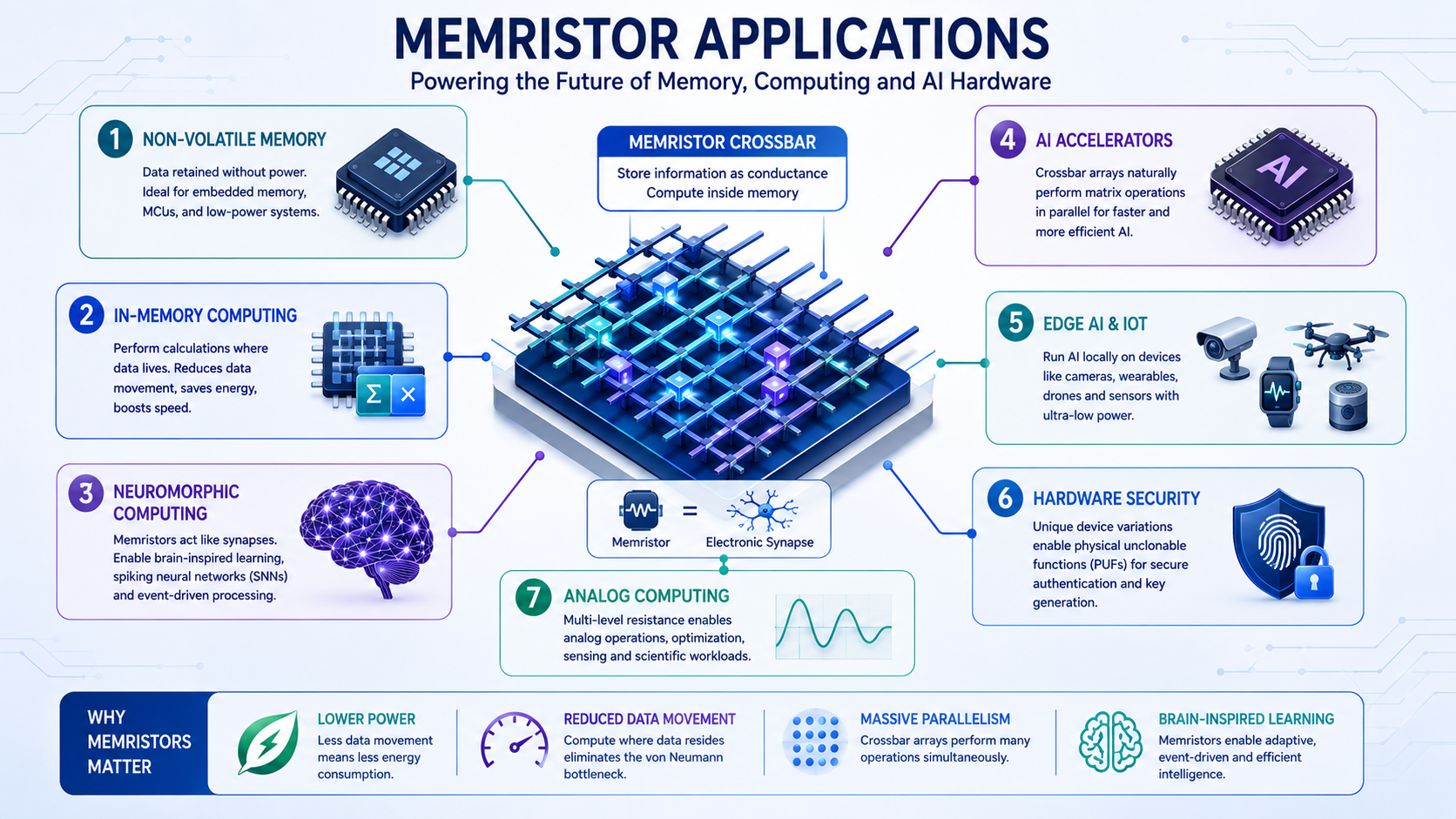
Key Applications of Memristors
1. Non-Volatile Memory
Memristors can store data without power. That makes them useful for embedded memory, microcontrollers, IoT devices, automotive electronics, and low-power systems.
ReRAM is one of the most practical forms of this idea.
2. In-Memory Computing
This is one of the strongest use cases. Instead of sending data to a processor, memristor arrays can perform parts of the computation directly inside memory.
This helps with AI workloads, signal processing, and data-heavy applications.
3. Neuromorphic Computing
Neuromorphic computing tries to build hardware that works more like the brain. The brain does not separate memory and processing the way normal computers do. Synapses store connection strength and also help process signals.
Memristors behave in a similar way. Their conductance can represent synaptic strength. Voltage pulses can make that connection stronger or weaker.
That makes them useful for brain-inspired learning systems.
4. AI Accelerators
AI accelerators need fast and efficient matrix operations. Memristor crossbars can support those operations in parallel. This makes them interesting for future AI chips, especially where energy efficiency matters more than raw cloud-scale performance.
5. Edge AI and IoT
Small devices cannot afford huge power budgets. Wearables, sensors, drones, smart cameras, and medical devices need local intelligence. Sending everything to the cloud is not always fast, private, or energy-efficient.
Memristor-based chips could help these devices run AI closer to the data source.
6. Hardware Security
Tiny differences between memristor devices can be useful. These natural differences can help create hardware fingerprints, also called physical unclonable functions. They may support device authentication and secure key generation.
7. Analog Computing
Some memristors can hold many resistance levels. That makes them useful for analog computing, where values are not only 0 or 1. This could help with optimization, sensing, and specialized scientific workloads.
Memristors in AI and Neuromorphic (Brain-Inspired) Computing
The most exciting role of memristors may be in AI hardware. Modern neural networks rely heavily on multiplying inputs by weights and adding the results. In software, this happens inside GPUs, TPUs, or CPUs. In memristor crossbars, the conductance of each memristor can act like a weight, and the current flowing through the array can naturally produce weighted sums.
This means a memristor crossbar can perform a core neural network operation directly in hardware.
The idea is powerful because it attacks the von Neumann bottleneck. Instead of storing neural weights in memory and repeatedly moving them to a processor, the weights remain inside the memristor array, where computation happens. This is also why memristors are attractive for spiking neural networks.
Spiking neural networks use short electrical pulses, similar to biological neurons. A memristor can change its state based on these pulses, making it suitable for learning rules inspired by biological synapses.
Current Research and Industry Progress
Memristor and ReRAM research has moved from theoretical interest to serious device and circuit development. Research groups are exploring memristor arrays for AI acceleration, analog computing, and neuromorphic learning. Semiconductor companies and memory startups are also investigating ReRAM for embedded non-volatile memory and secure hardware.
A major reason for this interest is that memristor-based devices can potentially integrate with CMOS manufacturing processes. This matters because any future memory technology must be produced at scale, not just to work in a laboratory, but in the field.
Still, commercial adoption is gradual. ReRAM is already appearing in specialized and embedded forms, but it has not replaced DRAM, SRAM, NAND Flash, or GPU memory. The more realistic future is hybrid, memristors may complement traditional technologies where their strengths are most useful.
Challenges and Limitations
Memristors still face some serious problems.
Device Variability
Two memristors may not behave exactly the same. This is a major issue for analog AI, where small conductance errors can affect accuracy.
Programming Precision
It is difficult to set a memristor to the exact resistance value you want. For digital memory, this is manageable. For AI weights, it is harder.
Endurance
Memory devices must survive many write cycles. Some memristors perform well, but endurance depends on materials and operating conditions.
Sneak-Path Currents
In passive crossbar arrays, current can flow through unwanted paths. This can cause errors and waste power. Selector devices or transistor-controlled cells are often needed.
Temperature Sensitivity
Resistance states can shift with temperature. This matters for cars, factories, outdoor sensors, and medical devices.
Yield and Defects
Large arrays need millions of reliable devices. Even a small defect rate can hurt performance unless the system is designed to tolerate faults.
Benchmarking Gaps
Many papers use different models, assumptions, and datasets. That makes comparisons difficult. The field needs stronger standards for reporting accuracy, energy, latency, area, and reliability.
Future Outlook
DRAM, SRAM, and Flash are too mature and too optimized. Memristors will probably not replace all existing memory right now, but may sit beside CMOS logic and traditional memory in near future. They may serve special roles where they are clearly better.
The most likely areas are:
- embedded non-volatile memory
- edge AI devices
- in-memory computing accelerators
- neuromorphic chips
- secure hardware
- low-power sensing systems
The long-term goal is not just better memory. It is a new style of energy efficient computing where storage and processing are no longer far apart.
Final Thoughts
Memristors matter because they challenge an old rule of computing. For decades, memory and processing were separate. Memristors blur that line. They store information through resistance. They can also help compute through conductance. This makes them valuable for ReRAM, AI accelerators, neuromorphic systems, edge devices, and in-memory computing.
The technology still has work ahead. Reliability, precision, endurance, variability, and manufacturing scale must improve. But the direction is clear.
As AI grows, moving data will become more expensive. Devices that reduce that movement will matter more. Memristors are one of the strongest candidates for that future.
Frequently Asked Questions (FAQs)
1. What is a memristor?
A memristor is a memory resistor. Its resistance changes based on past electrical signals, and it can keep that state even when power is off.
2. How is a memristor different from a transistor?
A transistor mainly acts as a switch or amplifier. A memristor acts as a memory element whose resistance can be programmed. Transistors control current flow, while memristors can store information in resistance states.
3. Is a memristor the same as ReRAM?
Not exactly. ReRAM is a memory technology based on resistive switching. Many ReRAM devices are often discussed as memristor-like devices.
4. Why are memristors important for AI?
AI requires many matrix-vector multiplications and large amounts of memory access. Memristor crossbars can store neural weights and perform weighted summations directly in hardware, which may reduce energy and data movement.
5.What is in-memory computing?
In-memory computing means performing computation where data is stored, instead of constantly moving data between memory and processor.
6. What is neuromorphic computing?
Neuromorphic computing is brain-inspired computing. It uses ideas such as neurons, synapses, spikes, and local learning.
7. Are memristors already used in real products?
ReRAM and related resistive memory technologies are being developed and used in some specialized embedded applications. They are not yet a universal replacement for DRAM, SRAM, or Flash.
8. What is the biggest challenge for memristors?
The biggest challenges are variability, precise programming, endurance, reliability, sneak-path currents, and large-scale manufacturing.
9. Will memristors replace GPUs?
Not directly. Memristors may support future AI accelerators, but GPUs will remain important. The more likely future is hybrid hardware.
Recent Articles
Decoding Patent Law: The Three Pillars of a True Invention
Memristors: The Tiny Devices That Could Change Memory and AI Hardware
The Founder’s Patent Path (Part 5 of 6) How to Protect Your Product Upgrades Without the 20-Year Cost
The Founder’s Patent Path (Part 1 of 6): How an “Imperfect” Patent Can Save Your Startup
Visitor Stats: