
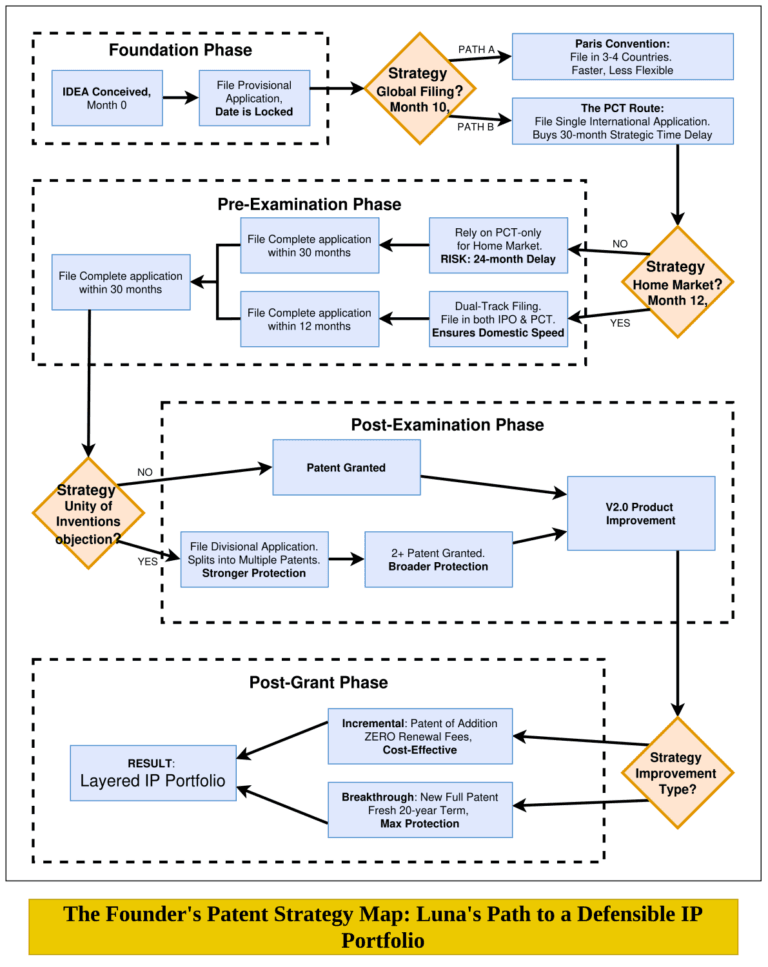
Prelude: Over the past five parts, we’ve followed Luna’s journey from a vulnerable innovator to a strategic leader with a robust IP portfolio. She navigated impossible deadlines, global expansion, painful mistakes, and legal curveballs. This final installment consolidates her entire journey into an actionable strategy map and answers the most critical questions founders face.
This flowchart maps the critical decisions Luna faced, the tools she used, and the outcomes she achieved. You can use it to navigate your own patent strategy.
12 Critical Patent Related FAQs For Innovators And Founders
Q1: We are about to demo to investors. Is an NDA enough?
No. An NDA is a weak shield. It’s hard to enforce and doesn’t prevent “independent invention” claims. A provisional application is a public, legal record that establishes you as the first inventor, regardless of what an investor does or sees.
Q2: Our product is evolving weekly. When is the “right time” to file a provisional?
The right time is now, based on what you have today. File a provisional with your current specs. For major new features developed later, file a new provisional. You can then combine them into one complete application. It’s better to have an “imperfect” date than no date at all.
Q3: We filed a PCT. Are we safe to publicly sell our product globally? Absolutely not.
The PCT only preserves your right to apply for patents in other countries. It does not grant any protection. If you sell your product, you publicly disclose it, and you will lose patent rights in most countries outside your PCT member states. You are only “safe” in a country once a patent is granted there.
Q4: A big company is using our invention, but our patent is still “pending.” What can we do?
Your options are limited until the patent grants. You can inform them of your pending patent, but you cannot sue for infringement. However, once the patent grants, you can sue for past damages from the date your application was published (usually 18 months from priority). Document everything meticulously for that future case.
Q5: The patent office says our invention is “obvious” based on prior art. How do we respond?
Don’t panic. This is common. Amend your claims to focus on the novel, non-obvious combination of features you’ve created. Argue why the specific combination of existing parts in your unique way solves a problem that wasn’t solved before. Use your specification’s detailed description to support your argument.
Q6: We are a SaaS company. Should we patent our algorithm or keep it a trade secret?
This is a core strategic decision.
- Patent: Grants a 20-year monopoly but requires full public disclosure. Best for algorithms that are hard to reverse-engineer and form the core of your defensible advantage.
- Trade Secret:Lasts forever but offers no protection if someone reverse-engineers or independently develops it. Best for behind-the-scenes processes that are impossible to detect from the front end. Many companies use a hybrid approach: patent the core, unique method, and keep auxiliary processes as trade secrets.
Q7: An ex-employee is building a similar product. What are our immediate steps?
- Secure Evidence: Document the similarities and any proof of knowledge (emails, code, etc.).
- Review Agreements: Check the employee’s contract for IP assignment and non-compete clauses.
- Legal Counsel: Immediately consult an IP litigator to send a cease-and-desist letter.
- Patent Status: If your patent is granted, you can sue. If it’s pending, you can warn them of future litigation upon grant.
Q8: We’re running out of money. Should we stop paying patent renewal fees?
This is a triage decision. Let go of the least critical patents first. Consider abandoning patents in non-core markets or for older technology generations. Never abandon your one or two core patents that protect your current revenue stream; try to find the money to keep them alive, as they are your most valuable assets.
Q9: Can we use “Patent Pending” on our product if we’ve only filed a provisional?
Yes, you can and should. The moment you file a provisional application, you can legally use “Patent Pending.” This applies to the product features covered in that provisional filing.
Q10: How do we find out if someone has already patented our idea?
Conduct a prior art search. You can start with free tools like Google Patents, USPTO’s database, or Lens.org. For a comprehensive search, especially for a freedom-to-operate analysis (ensuring you don’t infringe), hire a professional patent search firm or a qualified patent attorney.
Q11: A competitor’s patent is blocking us. What can we do?
You have several options:
- Design Around: Innovate to create a similar solution that doesn’t fall within the scope of their patent claims.
- Invalidate: Search for prior art that proves their invention wasn’t novel or was obvious. You can challenge the patent’s validity at the patent office.
- License: Negotiate a license to use their technology.
- Acquire: If possible and strategic, acquire the company or the patent.
Q12: We want to license our patent. How do we determine its value?
Patent valuation is complex but is based on:
- The Problem it Solves: How critical and expensive is the problem?
- Market Size: The potential revenue of the market it serves.
- Strength of Protection: How broad and defensible are the claims?
- Alternatives: Are there cheap or free workarounds? Common valuation methods include estimating the royalty income (a percentage of sales) or the cost it would take for the licensee to develop a similar technology from scratch.
The Final Word
Luna’s journey teaches us that patent strategy is not a one-time event. It’s a continuous process of making informed, strategic choices under uncertainty. The goal isn’t to collect patents but to build a defensible business moat that allows you to innovate with confidence.
You now have the entire map and the tools. All the best for your innovative endeavors.
This concludes “The Patent Playbook Every Founder Needs.” Missed a part? Find the full series here.
Recent Articles
Memristors: The Tiny Devices That Could Change Memory and AI Hardware
The Illusion of Memory: AI, Scarcity, and the Hidden Cost of Continuity
The Great Patent Paradox: How Tech Giants Win Big by Giving Their Best Ideas Away for Free
The “Oak Tree” That Wasn’t! A reflection sparked by art, belief, and a late-night search
Visitor Stats: