
Prelude: In Part 2, Luna made the strategically sound choice of filing a PCT application at Month 10. This secured her global priority date and bought her 30 months of runway to raise capital and validate markets before incurring the high costs of national phase filings. This flexibility came at a price, however, when she faced a decision about her home market.
At Month 12, the deadline to file a full Complete Application in the country of her original Provisional filing, India, arrived. Luna had successfully chosen global flexibility, but now she had to decide on domestic speed.
She had two final options for her home market, India:
- Dual-Track: File a separate, full Complete Application in India now, independent of her PCT filing. This would start Indian examination immediately.
- Strategic Delay: Let the Provisional lapse and plan to enter the Indian national phase through her PCT application much later, around Month 31.
Luna pulled up her market analysis. The numbers for India were underwhelming. Drone delivery regulations were ambiguous. The commercial market was nascent, mostly hobbyists and a few experimental agriculture pilots. Her revenue projections for the mature markets in Germany and the US were significantly higher. Filing a separate Indian Complete Application would cost upfront fees, require local attorney bandwidth, and demand valuable prosecution time for what looked like a low-priority sector. It felt like duplicating the effort she had just paid for with the PCT.
She made what seemed like a rational capital allocation decision: “We will save resources now and enter India through the PCT at Month 31. We’ll focus our limited capital on the international markets that actually matter.” Luna let her Indian Provisional Application lapse at Month 12 without filing the separate Complete Application. At the time, it felt like smart startup discipline: prioritizing resources toward markets with clear ROI potential.
But it cost her 24 months of market leadership.
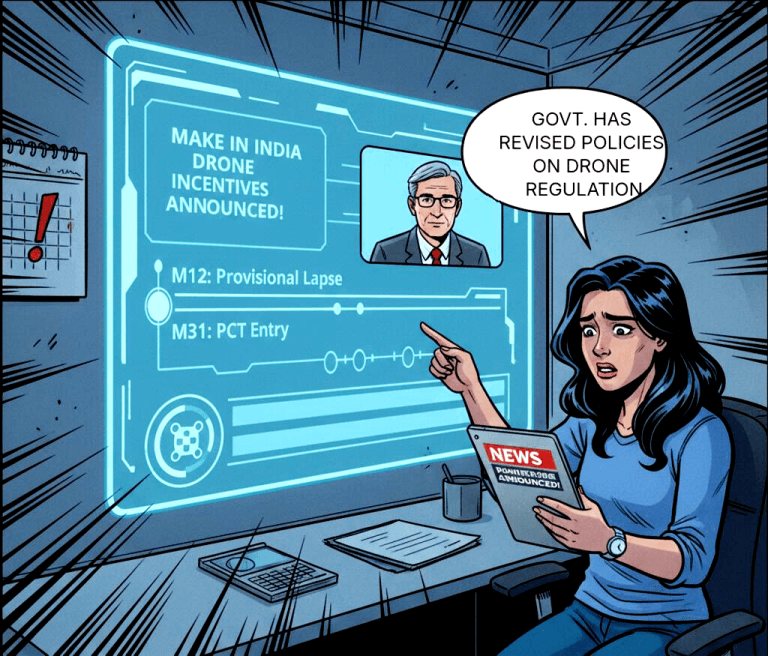
When Reality Shifts Faster Than Your Filing Strategy
Month 20 arrived with news that overturned her entire domestic strategy. The Indian government released a comprehensive drone policy reform package. The Ministry of Civil Aviation clarified regulatory frameworks, and detailed guidelines for BVLOS (Beyond Visual Line of Sight) operations, exactly what Luna’s stabilization technology enabled, were published. Commercial drone delivery, previously stuck in regulatory limbo, suddenly had a viable path forward.
But the announcement that made Luna’s heart sink was the “Make in India for Drones” initiative. The government was offering substantial subsidies, preferential government procurement, and fast-tracked regulatory approvals for drone manufacturers with indigenous technology protected by granted Indian patents.
Luna stared at the dates in her patent timeline spreadsheet:
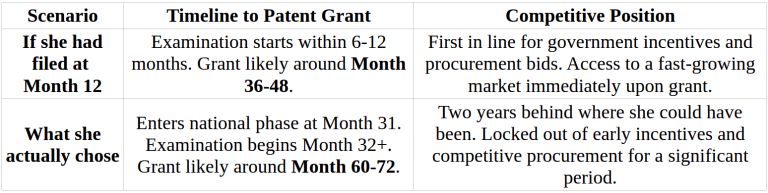
The Indian market she had deprioritized eight months earlier was now her fastest-growing, highest-opportunity sector. And she was facing a 24-month delay in accessing critical government subsidies and market advantage.
Luna called her consultant. “I made a mistake on India, didn’t I?“
The consultant was careful: “You made a defensible decision with the information available at Month 12. But yes, if we had known about these policy changes, filing a separate Indian Complete Application at Month 12 would have been the clearly superior choice.”
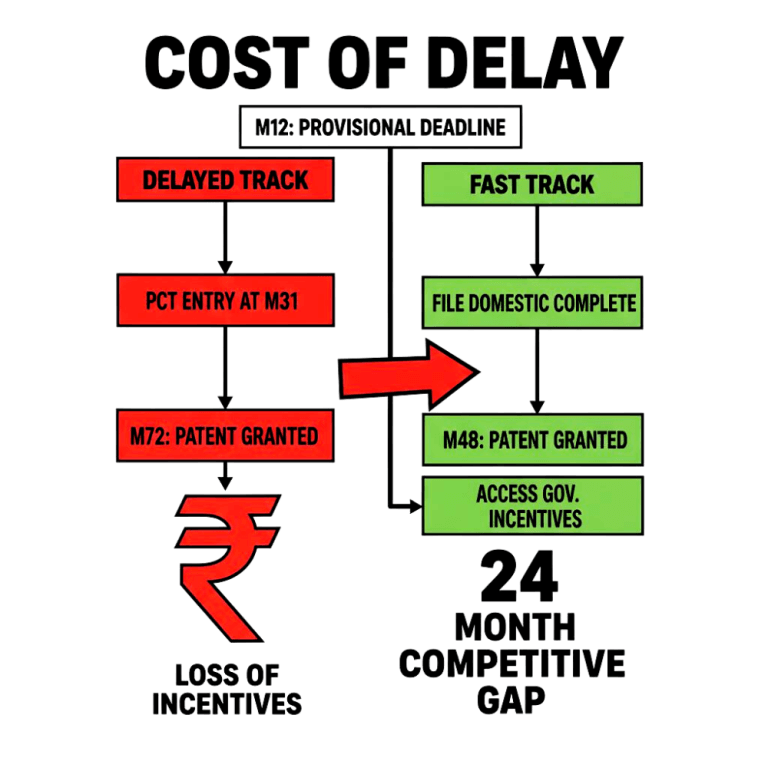
The painful lesson was clear: In terms of IP security, Luna lost nothing. Her PCT application ensured she retained her original Month 0 priority date when she entered national phase at Month 31. But in terms of competitive positioning, she lost 18 to 24 months of market advantage to any competitor who chose the faster domestic track. That is the tangible cost of the timing decision: the gap between having an enforceable granted patent versus being stuck in a long examination queue while others capitalize.
The Framework Luna Wished She'd Had at Month 12
I have spent days thinking about Luna’s decision. It was not a mistake; it was a trade-off made under uncertainty. But she learned the expensive way that strategic flexibility has limits.
She developed what she now calls her “Home Market Hedging Principle.“
You should file a separate domestic Complete Application (Dual-Track) at the 12-month mark (instead of delaying through PCT) if ANYof these conditions might be true for your home market:
- Policy Risk is High: Government procurement, subsidies, or regulatory advantages require domestic patent status (or a status better than “under examination”). Governments can change incentive structures faster than patent prosecution timelines.
- Enforcement Speed Matters: There is a realistic scenario where you discover that a competitor is using your invention. With a granted patent, you can immediately send a legal notice and file a lawsuit. A granted patent lets you sue and negotiate from strength. “Patent Pending” status doesn’t.
- Short Market Horizon: Your home country could become strategically important for revenue or manufacturing within the next 24-36 months. The 24-month delay from waiting for PCT National Phase entry is a massive competitive vulnerability.
Luna’s brutal lesson: Strategic flexibility is valuable, but strategic optionality on your home market can cost you years of competitive advantage.
The Next Crisis Luna Didn't See Coming
Luna entered the Indian National Phase at Month 31, committed to the long timeline. She had refined her claims and felt prepared for typical examination objections, prior art challenges and clarity issues.
Then, at Month 35, the First Examination Report landed with a new, unexpected objection: “Lack of unity of invention“.
Her application claimed the drone stabilization algorithm AND the physical frame design as a single invention. The Patent Office disagreed, arguing these were two fundamentally different technical solutions that needed to be separated. She was being told to choose: abandon one invention to keep the other.
Next Part 4: Turning a Patent Rejection into a Strategic Win: The Divisional Application. (The objection that looked like a disaster but was actually an invitation to secure broader, more defensible IP.)
Frequently Asked Questions (FAQs)
Q1: If Luna let her Indian provisional lapse at Month 12, did she lose her priority date for India?
No. The priority date is separate from the application’s status. When Luna filed her PCT application at Month 10, she claimed priority from her Indian provisional filed at Month 0. Even though that provisional lapsed at Month 12, the priority date of Month 0 was already “locked into” her PCT application. When she enters Indian national phase at Month 31, that application retains the original priority date.
Q2: Could Luna have filed both PCT and a separate Indian Complete Application at Month 12?
Yes, absolutely. This “dual-track” filing is actually common for applicants whose home market might become strategically important. It provides the best of both worlds: global flexibility (via PCT) and domestic speed (via the separate Complete Application). The cost is higher upfront, but that cost is the premium for strategic optionality.
Q3: Can Luna still benefit from the new Indian government incentives even though her patent isn't granted yet?
Partially. Some government programs require granted patents, while others may accept “patent pending” status or applications under examination. Luna will need to check the specific eligibility criteria for each program. However, the competitive disadvantage is real, companies with granted Indian patents can participate in procurement bids and subsidy programs that Luna will have to wait 18-24 more months to access.
Q4: Is there any way Luna could have predicted the Indian policy changes at Month 12?
Probably not with certainty, but she could have hedged better by monitoring policy signals. Government working groups on drone regulations, Ministry of Civil Aviation consultation papers, and industry advocacy efforts often precede major policy announcements by 12-18 months. A more thorough policy landscape analysis at Month 10-12 might have revealed that regulatory changes were likely.
Q5: Does this mean startups should always file domestic Complete Applications even if their home market looks weak?
Not always, but Luna’s experience suggests a conservative approach: If your home market has any non-zero probability of becoming strategically important, whether through policy changes, regulatory clarification, or market development, the cost of filing a domestic Complete Application is usually smaller than the opportunity cost of being 2+ years late to capitalize on unexpected market improvements. The exceptions are when capital is so constrained that dual-track filing threatens survival, or when your business model genuinely has zero domestic market exposure.
Recent Articles
The Illusion of the One Big Answer: Why Experts Think in Frameworks, Not Solutions
The Fusion of Art & Technology: A Renaissance or an Insult to Life?
The Founder’s Patent Path (Part 2 of 6) The Global Patent Strategy: Why a 30-Month Delay Could Be a Smart Move
The Founder’s Patent Path (Part 3 of 6) The Home Market Blindspot: How to Avoid Losing Your Competitive Edge
Visitor Stats: