
The true challenge for a founder lies in how a brilliant idea is protected and turned into a defensible asset for sustainable growth. This is the story of how one founder faced that test, and the simple tools that saved her company. This 6 part article series documents my journey learning the strategic IP toolkit through a story that might mirror the challenges faced by countless CTOs and founders in India and abroad.
Let me introduce you to Luna.
I chose the name Luna Lovegood deliberately because she sees things others dismiss as impossible. Luna runs a small hardware startup. For months, her team had worked in near-obsessive focus, cracking a problem that had stumped larger companies. A drone stabilization algorithm that kept UAVs perfectly steady in high winds. The code was brilliant and simulations were flawless. Her core innovation was ready to disrupt the market.
But the physical reality was less glamorous. The prototype was still in pieces on the workshop bench. Wires snaked between sensors, and the custom frame was held together with strategic optimism. The invention was mature in theory, but not in its final, patent-ready form. This is the innovator’s vulnerability: the world moves faster than your documentation.
Then, the email arrived. An invitation to demo at the biggest international drone expo of the year. The investors she desperately needed for scaling the innovation, would be there. It was the moment that would decide whether her company lived or died.
The problem? The expo was in four weeks
This opportunity was a trap, built on a fundamental pillar of patent law: Novelty. Under patent law, if Luna presented her algorithm publicly through a detailed demo, a pitch deck, or a technical paper, she would be legally “disclosing” her invention to the world. Public disclosure, in most major jurisdictions, destroys novelty. Once the world sees it, especially in some major jurisdiction like the European Union, you cannot patent it. Your invention is immediately donated to the public domain.
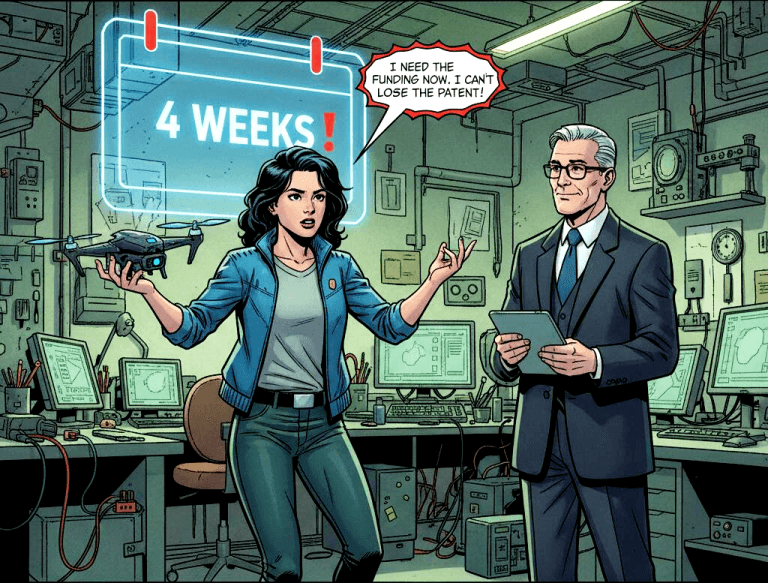
Luna was facing an existential choice that kills promising companies every day:
- Option A: Present and Disclose. Secure the critical seed funding to keep the company alive, but permanently surrender the core technology’s protection.
- Option B: Stay Silent and Perish. Keep her IP safe, but lose the funding, the market visibility, and the crucial momentum that keeps a startup alive.
When I first understood this dilemma, I thought that the system seems unfair & it couldn’t be designed to punish innovators for seeking funding. That is when I discovered the solution. A tool that reframes the entire narrative: the Provisional Application.
The Solution! "Priority Bookmark": Your Idea's Legal Birth Certificate
A Provisional Application is not a lesser patent. It is a strategic instrument designed for the messy reality of innovation.
Think of it this way: A full, complete patent application is like a complex legal document, a passport for your idea. It requires a finalized invention, rigorous claims, and perfect details. It is expensive and time-consuming. A Provisional Application is different. It is your idea’s legal birth certificate.
Its sole purpose is to establish an official, unchangeable date of conception, your Priority Date. It does not need to be perfect. It does not require formal claims or a working prototype. You file it with whatever documents you have that prove the idea in sufficient detail. Algorithm pseudocode, simulation results, technical drawings, and system architecture diagrams etc.
The moment you file it, that date becomes your official “I was here first” stamp in the global patent system. Any competitor who files a similar invention after your provisional date is automatically second in line. Also, any subsequent public disclosure including your own presentation at the expo, cannot be used against your patent’s novelty, because the legal “birthday” is already secured.
For Luna, this was the lifeline. Her team did not wait for perfection. They quickly compiled all their existing documents and filed the Provisional Application three days before the expo.
The Ripple Effect: Three Strategic Wins from One "Imperfect" Filing
Filing the provisional not only just solve Luna’s immediate crisis, but also created a cascade of strategic advantages that fundamentally strengthened her position.
- The Ultimate De-risking Tool: The “Priority Date” was secured. Luna walked into that expo with absolute confidence. The demo was no longer a threat to her IP, it was a showcase of a protected asset. She could pitch, present technical details, and secure funding without the fear of destroying her company’s most valuable asset. This safety net is the primary weapon against the public disclosure trap.
- The “Patent Pending” Power-Up: Those two simple words, “Patent Pending”, on her pitch deck and in her press materials changed the entire conversation with investors. It signaled that the team was not just technically brilliant, but commercially savvy. They had protected their moat. For investors evaluating dozens of risky startups, this single step of de-risking the IP often becomes the critical differentiator between a “maybe” and a “yes.”
- The 12-Month Runway to Perfection: This is the system’s true genius for a startup. The provisional filing starts a 12-month clock. Luna now had a full year to perfect the hardware, iterate on the algorithm based on real-world feedback, close her Series A funding, and prepare the rigorous, expensive Complete Application. The provisional is not for finished inventions; it is the ideal protective cover for brilliant ideas in motion, giving you the time to turn your prototype into a product.
Luna got her funding.More importantly, she learned that patent law is not a set of bureaucratic hurdles, but a toolkit designed for the chaos of a startup.
The Strategic Takeaway: A Tool for Chaos
What I learned from Luna’s experience is that the gap between what engineers know and what patent law requires, is where companies die. How many brilliant teams have presented at expos, published papers, or pitched to the wrong investor before filing, and unknowingly destroyed their own patent rights?
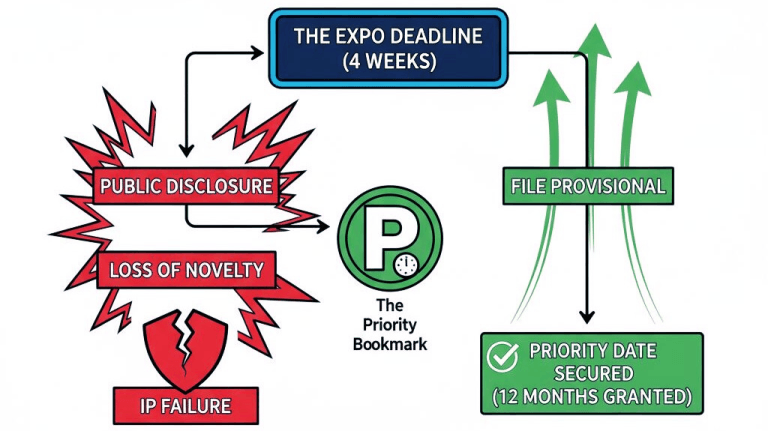
The Provisional Application exists because the legal system recognizes the real-world chaosof the innovation cycle. It is the tool that allows you to be both agile and protected, to move at market speed without sacrificing legal security.
The hidden cost for most founders is simply not knowing this tool exists. Luna’s story is a testament to the power of using it strategically.
Luna solved her first crisis. The Provisional Application gave her the time and safety she needed. But her success at the expo brought a new, far more complex challenge: international protection. Her investors were now asking: “We have a priority date in India. But our customers are in Germany, the USA, and Japan. How do we turn this ‘Patent Pending’ status into global protection on a startup budget?” That is where the real strategic decisions begin.
Next: Part 2: The Global Patent Strategy: Why a 30-Month Delay Could Be a Smart Move. (The critical decision that determines whether you have one year or two and a half years to validate your global markets before spending major capital.)
Frequently Asked Questions (FAQs)
Q1: What is the single biggest mistake an inventor can make with a Provisional Application?
Filing a lazy or incomplete description. The provisional only protects what you explicitly disclose. If you invent a key feature after filing the provisional, that new feature does not get the original priority date. It is critical to be as detailed as possible, even if the description feels premature. Include every variation, component, and operational concept you have considered.
Q2: Does "Patent Pending" legally stop anyone from copying my invention?
No. This is a dangerous misconception. “Patent Pending” gives you no right to sue for infringement, that right only materializes after the patent is formally granted. However, it is a powerful deterrent. It serves as a strong warning to competitors that a patent may soon be issued, at which point their infringing activities will become legally actionable. Most smart companies will avoid this risk.
Q3: Can I file a provisional application for a new product design or brand logo?
No. Provisional applications are specifically for utility patents, inventions related to new processes, machines, compositions of matter, or improvements thereof. Product designs (ornamental appearance) are protected by design patents, and brand logos are protected by trademarks. Neither of these has a provisional option.
Q4: Is my Provisional Application kept confidential?
Yes, entirely. The Patent Office keeps it secret. It is never published unless you file a corresponding Complete Application, which typically gets published 18 months after the priority date. If you abandon the invention and never file the Complete Application, your provisional filing never sees the light of day (there are edge cases though, that we will explore in next parts in this article series). This is a key advantage, as it allows you to test the waters before committing to a full, public disclosure process.
Q5: What if I improve my invention significantly during the 12-month provisional period?
You have a strategic choice. If the improvement is minor, you can simply add it to your Complete Application, though the new feature won’t benefit from the original priority date. The safest and most strategically sound approach for a significant improvement is to file a new Provisional Application for the new feature as soon as you develop it (the other possible solutions are discussed in the next parts of this article series). You can then file a single Complete Application claiming priority from both provisional applications, ensuring every aspect of your V1.0 and V1.1 is protected from its earliest date.
Q6: What happens if I miss the 12-month deadline for the Complete Application?
The provisional application is automatically abandoned. You permanently lose that priority date unless already applied for other routes like PCT. You can still file a brand new patent application, but its priority date will be the new filing date, making you vulnerable to anything published in that 12-month gap, including your own public disclosures at the expo, investor pitches, or competitor filings. This makes meticulous calendar management non-negotiable in patent strategy.
Learn More: https://lnkd.in/dpqWrKdF
Recent Articles
How Renesas’ Smart BLE Labels Are Transforming Real-World Asset Visibility
From Molecules to Models: Rethinking Life, Intelligence, and Everything In Between
The Founder’s Patent Path (Part 5 of 6) How to Protect Your Product Upgrades Without the 20-Year Cost
Memristors: The Tiny Devices That Could Change Memory and AI Hardware
Visitor Stats: