
Imagine you have just made a breakthrough. You have the prototype, the data, and the great excitement of knowing you have created something genuinely new. You are ready to share it with the world to publish the paper, pitch the investors, or start selling the product.
But STOP! This one moment, this excitement to share, can be the most dangerous moment in the entire life of your invention. A single email, a casual presentation, or an early publication could destroy your right to patent that breakthrough forever. Believe me, when I started my journey from an engineer to understanding Intellectual Property (IP) law, I quickly learned that the law is a minefield for the person who is not aware. Timing and disclosure are everything.
Your Brilliant Idea Might Already Be Unpatentable
For many years, I thought getting a patent was only about having a breakthrough idea. I was wrong. The patent process is full of technical-legal traps that have nothing to do with how innovative your idea is, and everything to do with how you manage the information. I have seen brilliant inventors, people much smarter than me in the technical details, make simple, irreversible mistakes because they did not know these rules.
Here are the three biggest traps that can invalidate your patent before you even file, based on the laws in India and other key markets, and the strategic solutions that I have learned to rely on.
Trap #1: The "Publish or Perish" Dilemma (The Grace Period Trap)
The Problem: The Conflict of Pressure
In the world of research, there is a massive conflict. The legal system strictly says: “Keep the details secret until you file the patent.” But your career, your professor, or your investor says: “You must publish the findings to secure funding or attract attention.” This conflict is the most common and damaging mistake for new inventors.
The Trap: Your Own Work Becomes Your Enemy
The moment you publicly disclose your invention and “publicly disclose” means anything that makes the information available to a non-confidential person, that information immediately becomes Prior Art against your own patent application. I remember one case where an engineer presented his new sensor design at a small local conference. Three months later, his own slides, available on the conference website, were technically enough to destroy his patent’s novelty.
Now, some places like the United States and India offer a small safety net called a 12-month grace period. This means you have one year from your own public disclosure to file an application. But please, listen carefully: this grace period is a local, friendly rule.
The Global Pitfall: Losing the World Market
The biggest danger is that this grace period does not exist in most of the major patent markets, especially Europe. They follow the strict absolute noveltyrule. For them, if you publish on Monday and file your patent on Tuesday, your publication has already destroyed your novelty everywhere outside of your home safety net.
If you are a startup with global ambition, losing the European market because of one premature paper is a disaster you cannot fix.
The Strategic Solution: The Priority Date Safety Switch
The fix is simple, elegant, and fast: File First.
The mechanism for this is the Provisional Patent Application (PPA). When I first learned about the PPA, it felt like a magical legal safety switch. It is a very fast, low-cost filing that instantly establishes your priority date. Once you have that PPA priority date, you are legally protected to publish, present, and pitch your idea. You then have a full 12 months to conduct further R&D and file the complete, formal patent application, all while keeping the protection of your first filing date.

Trap #2: The "Slightly Better" Fallacy (The Evergreening Trap)
The Problem: Commercial Value vs. Legal Efficacy
As an engineer, I know that making a known drug more stable or cheaper to manufacture is a massive commercial breakthrough. But I learned the hard way that commercial value is not the same as legal patentable value, especially in India. This trap happens when companies try to extend their monopoly on an old drug by patenting a minor variation, like a new salt or a different crystalline form. This is called “evergreening.”
The Trap: The Efficacy Demand of Section 3(d)
The Indian Patents Act has a specific, powerful rule, Section 3(d), to stop this. It clearly states that a new form of a known substance is not patentable unless it can demonstrate a significant enhancement in therapeutic efficacy.
The consequence is strict: a minor modification is treated as an obvious variation. You made it cheaper? Not enough. You made it more stable on the shelf? Not enough. The law demands that your new form must work genuinely better inside the patient.
The Real-World Consequence: My Lessons from the Novartis Case
I spent a lot of time studying the famous case of Novartis’s cancer drug, Gleevec. Novartis was claiming a new, supposedly superior crystalline form. The courts ruled that the new form did not show significantly enhanced efficacy, and they rejected the patent.
This case taught me that the law is not just about technical innovation; it’s about public benefit and stopping the monopoly of minor changes. The lesson is undeniable: your new drug form must show a superior, measurable benefit in the body.
The Strategic Solution: Proving the Benefit
If you are an inventor claiming a new form of a known substance, you cannot rely on manufacturing advantages. You must back your claim with robust, quantifiable clinical or pharmacological datathat clearly proves the new form provides a superior and non-obvious therapeutic benefit over the original substance. This evidence must be strong and undeniable.
Trap #3: The "Lego" Mistake (The Mere Arrangement Trap)
The Problem: The Engineer’s Instinct to Combine
As an engineer, I know we combine existing components like circuits, sensors, software to solve new problems. Many inventors think that combining existing, off-the-shelf parts automatically creates a patentable invention. This is a very big mistake.
The Trap: The Independent Function Rule of Section 3(f)
Patent law in India explicitly guards against this in Section 3(f). This rule says that “the mere arrangement or re-arrangement or duplication of known devices, each functioning independently of the others in a known way” is not an invention.
For example: combining an existing LED lamp, a well-known dimmer switch, and a standard adjustable stand into one product. The lamp is still just a lamp, the dimmer is still just a dimmer. Each part does its original, known job, without affecting the others. The invention is rejected as “obvious” because there is no true technical integration.
The Strategic Solution: The Power of Synergy
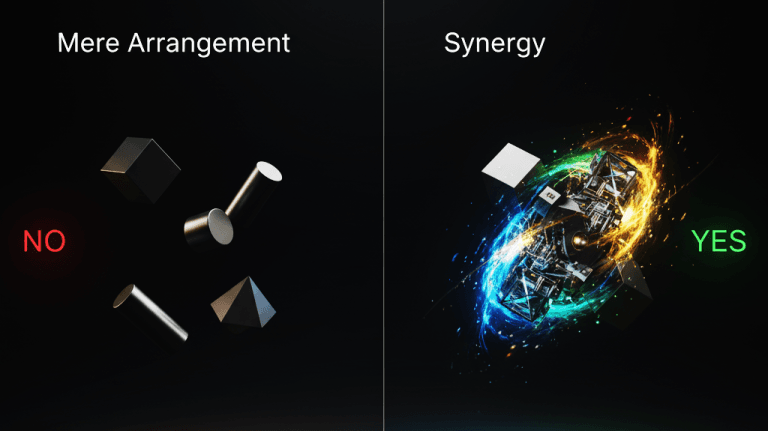
To successfully overcome the “Lego” trap, your combined invention must demonstrate Synergy. This means you must prove that the components interact with one another in a new way to produce a unified result that is greater than the sum of its individual parts.
For instance, if the new arrangement causes the components to perform a completely new function such as a specific software collaboration that yields an unexpected technical advantage, then you have demonstrated synergy. Your claim must focus on the novel interaction, not just the simple assembly.
Conclusion: Think Before You Disclose
The patent process is challenging, and these three traps, the risks of Premature Disclosure, the fallacy of Trivial Modification, and the mistake of Mere Combination, are the most common reasons why genuinely brilliant innovations are rejected.
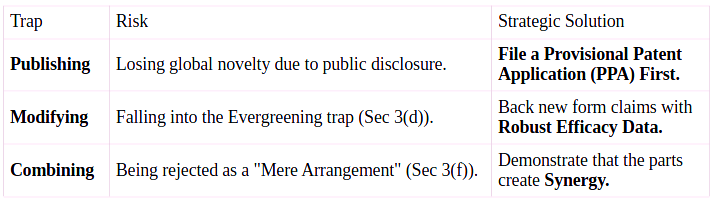
The single most important lesson I have learned in my transition to IP law is simple: File First. Before you talk, present, or publish, secure your priority date. It is the one mistake in your IP journey you truly cannot undo.
Frequently Asked Questions (FAQs)
1. What does it mean that my own disclosure is "Prior Art"?
It means that any public sharing of your invention, your own research paper, conference presentation, or un-watermarked marketing material is considered existing public knowledge. If you share it publicly and then file your patent, that public sharing can be used to argue that your subsequent patent application lacks novelty, since it was already publicly available.
2. How does a Provisional Patent Application (PPA) help avoid Trap #1?
A PPA is a fast, low-cost legal placeholder. It establishes your priority date, the legally recognized date of your invention, with minimal effort. Once your PPA is filed, you can proceed with publication or public pitching knowing that your priority date is secured. You then have 12 months to file the complete, formal patent application.
3. What is the "Absolute Novelty" rule, and why should I care if I'm only filing in India?
The Absolute Novelty rule means that anypublic disclosure before the filing date, even your own, destroys novelty for a subsequent patent application. You must care because if you publish before filing, you will permanently lose the right to file for patent protection in major markets like Europe, regardless of any grace period in your home country.
4. If my new drug form is 10x cheaper to make, is that enough for patentability under Section 3(d)?
No. Under Indian patent law (Section 3(d)), a new form of a known substance requires demonstration of significantly enhanced therapeutic efficacy, meaning it must work notably better for the patient. Cost reduction or manufacturing convenience alone is generally insufficient to overcome this hurdle.
5. How can I prove "Synergy" to avoid the "Lego" Trap (Section 3(f))?
To prove synergy, you must show that the combined parts produce an unexpectedly better result or a new function that is not merely the sum of their individual, known functions. This requires technical evidence that the components interact chemically, mechanically, or electronically to achieve a result that an expert in the field would not have predicted.
6. What if I shared the idea under a Non-Disclosure Agreement (NDA)? Is that considered public disclosure?
Sharing an idea under a valid, legally binding Non-Disclosure Agreement (NDA) is generally not considered public disclosure and will not count as Prior Art. NDAs are a critical tool for innovators to safely discuss their invention with investors, partners, or manufacturers before filing a patent.
Recent Articles
The Illusion of Memory: AI, Scarcity, and the Hidden Cost of Continuity
The Founder’s Patent Path (Part 4 of 6) Turning a Patent Rejection into a Strategic Win: The Divisional Application
From Molecules to Models: Rethinking Life, Intelligence, and Everything In Between
How Renesas’ Smart BLE Labels Are Transforming Real-World Asset Visibility
Visitor Stats: